Celebrating writing “The End”

This is really hard for me, so I’m just going to blurt it out. I am proud of myself. Whoa, honey. No one likes a braggart. Probably everyone is going to stop reading this post now, right?

When I walked away from my career last September I had one goal: to finish my novel and make it good enough for my mom to read. Why my mom, you ask? Because she’s a devourer of all types of books and no matter what genre I wrote, she would appreciate it. Because she’s an English teacher and could tell me if my book actually met standard and historical book criteria. I love books because my mom loves books and she encouraged me to read whatever I wanted my entire life. (She actually had to stand up to the elementary school librarian on my behalf for reading a “age inappropriate” books. Poor librarian.) I wanted to write this book, because it was a story I wanted to read and I wanted to share it with my mom.

On Friday June 13th I wrote “The End.” (Which is a totally fine date to finish your novel. No bad omens associated with Friday the thirteenth at all.) Then I read and edited and spell checked and edited some more until June 23rd when I printed out all 285 pages and presented it to mom. Part one of my goal accomplished.
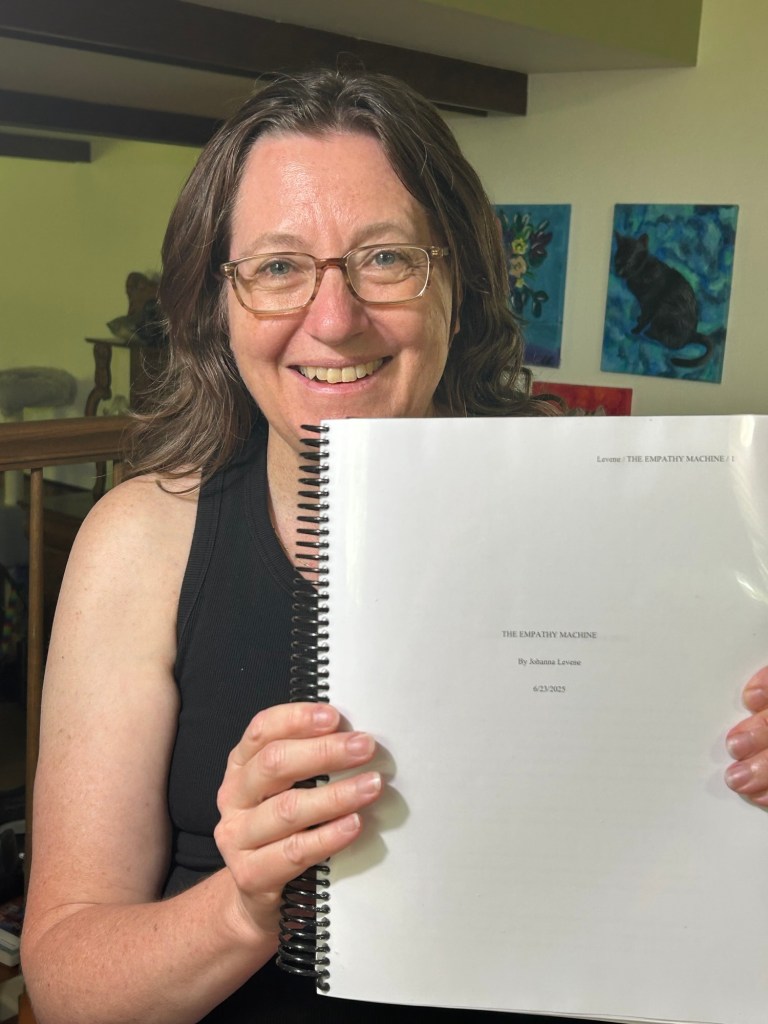
(Mom took this picture of me and my book. We are at her kitchen table. I normally hate how I look in pictures, but not this time. Look at how happy I am.)

I’ve read many writing books. I think Stephen King is the one who said that writing is magic. In my head was a world, characters and actions. Part one of the magic is the transference from my head onto the paper. To the best of my abilities, I accomplished that. I’ve read my complete book twice since writing “The End” and I believe the story is there. Could it be better? Yeah. (The comma situation is certainly dicey.) Could the story be better? Maybe, but not from what my own eyes can see or my own brain can comprehend. Now I need to find out if I accomplished the second part of the magic: can someone else’s eyes and brain read the story and interpret it? I don’t know, but I’m about to find out. Feedback from my mom, my writing group, and my husband is coming. I’m trying to be brave.

I have little glimmers that give me hope. As they have finished, my writing group has sent texts saying “It’s wonderful” and “It’s a big wonderful book.” (At 107,000 words, it’s a bit of a behemoth.) Mom finished on July 7th and sent me a picture of the last page of my book. On it she wrote, “So good” underlined three times and “I got teary eyed.” I got teary eyed when she sent me the picture.
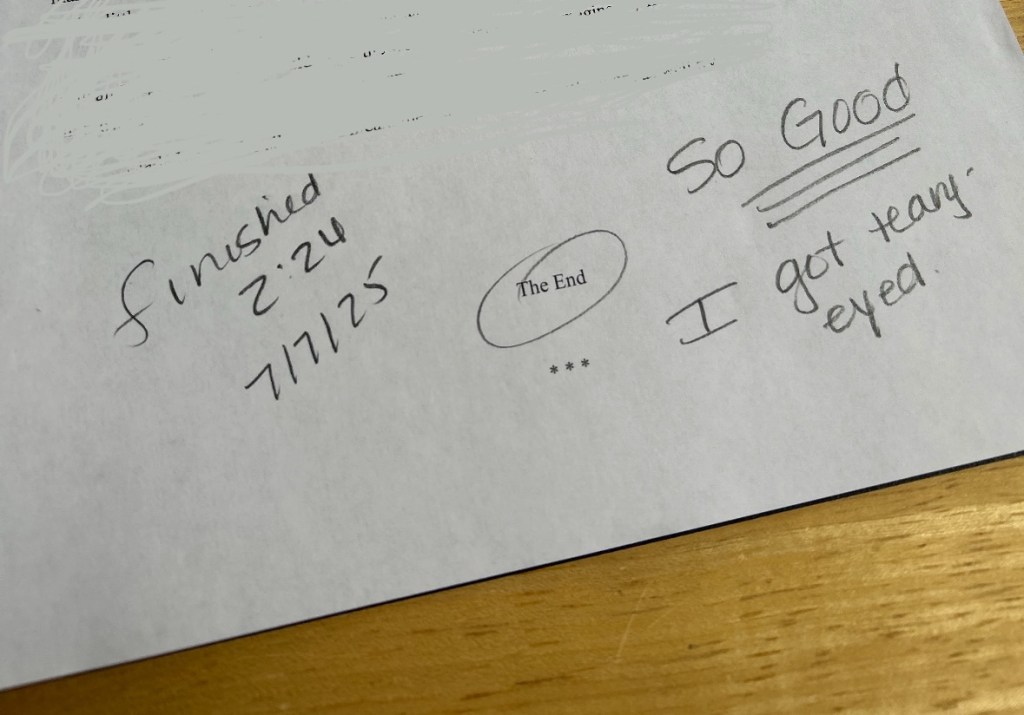
Mom’s “The End”

I’ve had a month to celebrate. A month to marvel at my accomplishment. I left 20 years of stability, a nice paycheck, and great benefits for a dream. That dream is now a physical hunk of word-filled paper big enough to cause death to a bug or pain to a foot if dropped.

No matter what the next few weeks of critique and discussion brings, I want to acknowledge that I achieved my dream and that’s pretty gosh darn amazing. (I can say that here, because everyone stopped reading after the first braggy paragraph, right?)

The End

So, Watcha been Doin’?

My desk at Library #4

It’s been two weeks since I left my job to live the dream of being a full time writer. Inevitably, everyone’s first questions are “Are you writing?” or “How’s your book coming?” My first week I had a list of activities that would prove to myself and my friends that I was doing the writing thing. I investigated libraries as writing offices. I became my own tech support and installed a new battery in my laptop, then downloaded Scrivner (a software package for writers). I took the Scrivner tutorial, then found all my novel files, and uploaded them into the Scrivner novel template. I rearranged my desk into a writer’s desk, rather than a worker’s desk. I wrote a blog post. I made a writing plan. I worked on a short story. I created a to-do list for my novel rewrite. I started reading a writing book. Look at me becoming a full-time-writer.

But I also left my job for personal reasons. My connections to people outside of work were degrading. So I made cookies for a friend who had a death in the family. I attended parent teacher conferences. I went to therapy. I sent a short story to my mom, so she could help make it better. I went on an anniversary hike with my husband and cut his hair. I fixed our YMCA membership so I could start taking classes and work on my physical health. I managed to slowly run a 5k. I drove my kid to volunteer activities and concerts and helped rescue her broken car. Look at me fixing myself and my friends and family.

The first week was just like working, but at a different job, which is what I told everyone I was going to do. I was proud of my accomplishments, and friends were impressed with how I’d transitioned right over to this new life.

The second week tells a different story.

I also left my job because I was exhausted and my personal life and home life were suffering. All that came crashing in the second week. The cat boxes and guinea pig cages were filthy. I still had seven performance reviews to write for the job I quit. (Yeah, I know, unpaid labor, but it was for people I care about.) My health insurance expires soon, so I got my COVID and flu shots, then spent a day and a half asleep in bed. (My normal booster after-effects, but since my only COVID infection lasted 10 days, I keep getting boosted.) I had my final OB/GYN appointment complete with pap smear. Midweek, I tried a full self-care yoga-mom day: I bought tickets for our winter trip; I actually went to a yoga class; I got my nails done with my daughter (homecoming for her, simple vanity for me). I tried to include more people in my week. I had lunch and walked with friends and spent an hour picking apples with my mom in her backyard. The weekend was filled with homecoming activities – volunteering, unexpectedly staying for the football game to visit with friends, steaming my kid’s dress, taking homecoming pictures, and delivering forgotten items around town. The only writer thing I accomplished was working on my short story, visiting a third library, and thinking a lot about my book. One might say I failed week 2 as a writer.

Three weeks ago my days were dictated by my Outlook calendar. Life was scheduled from 8-4 (or 7-6 on a bad day) in half hour or hour chunks going from meeting to meeting to meeting. Often I didn’t have time for lunch, and bathroom breaks were quick jaunts where I had to wait to start my next conference call because you could hear the toilet flushing from my desk. Milestones were set and documented with clients. I had no time to think deeply or be thoughtful.

My other issue is that I’ve been working since I was 14, and working full time since I was 23. Gosh. I’ve been working full time more than half my life. The only break I’ve had in those 27 years was 13 weeks for maternity leave. Okay, I also went down to 32 hours for about a year when my kiddo had non-stop ear infections, and then went down to 32 hours during my last year of my master’s degree, but in both of those cases the extra hours I wasn’t workin’ for the man were dictated by someone other than me. It wasn’t like this. I really don’t know how to not work a regular job.

This is a whole different life in an unexpected way. I’m responsible for deciding what I’m going to do. I’ll write my own performance review. I get to report if I’m succeeding or failing. Am I allowed to take a day off? Can I knit during working hours? Can I write after hours? What are my hours? Is napping allowed? Someone forgot to give me the unemployed workers handbook. This week, I’m going to choose to be kind to myself. Anyone who has worked for me will say that I tell everyone to expect a struggle in the first 3 months of a new job. I’m going to give myself a little of my own managerial grace as I figure this out.

I’m writing this post from library number four. (Oddly, a library I started working at when I was 16.) So far, I’ve found 3 of the 4 libraries to be productive writing work spaces. They have the right amount of background noise and I like being surrounded by books. Today I was able to research points of view from books in the 808 nonfiction section. (I love the Dewey Decimal System.) I’ve got a plan for figuring out if my novel needs first person, third person omniscient, or an editorial narrator. I’m excited about doing some writing on my actual book, not because it’s on a to do list, but because I’m curious. Tonight is writer’s group and I have a writing conference this weekend. I have absolutely promised myself that I won’t let the writing conference crush my soul, as they often do. If I start to hate a session I can leave. I don’t have to go the whole time.

I’m glad that I’m keeping track of my days, because I want to know what makes a day good and productive and what days are frustrating. Just like in my other job, I’ve found that the to-do items I don’t finish make me angry at myself, but I still forget all the things I did accomplish. Going back to review makes me feel better. I haven’t “wasted two weeks” because I haven’t rewritten 87 pages of my novel. I’m being thoughtful with my time and activities. Instead of thinking that I’ve squandered 1/26th of my year off, I’m going to focus on how I’ve set myself up to make the next 25/26ths a success, however I end up defining success.

Happy Birthday to Me

For my 50th birthday I am giving myself a gift. The biggest gift (monetarily) I will ever give or receive. (Well unless I get all philosophical and consider the gift of life to my kid, but that’s outside the scope of this post.) I am quitting my job to take a year off to write my book. Goodbye annual salary, hello priceless time.

I started this book in 2013, eleven years ago. Since then I’ve raised my kid to driving age, started and finished a master’s degree, got promoted, grew my team to twenty-three people, visited the White House and increased our team’s portfolio to $10M dollars. But do you know what I haven’t done? I haven’t written my book. I published an essay, a satire piece, and a short story, and was racing into 2020 on a high of acceptances. But then my writing started suffering. It suffered because, for me, a global pandemic and a creative mindset did not go hand in hand. It also suffered because of my master’s capstone completion in November of 2020 and my subsequent brain-fry hangover. It suffered because I took an “opportunity” to do a second role at the same place I already had a job. But about a year ago, I was down to one job, my degree was a memory in a frame, I survived COVID, and the creativity dam broke and I really, really, really wanted to start writing again.

Only an idiot would quit their lucrative high-paying career as a 50-year-old woman. I don’t have a single friend who can’t tell a horror story about a middle-aged woman getting forced out for being too old. I myself was recently informed, by a younger male colleague, that I wasn’t “hungry enough” to do my job effectively. If I quit now, I might never work again. This is conventional wisdom and even my six page list of contacts isn’t enough to make me consider that I’m not murdering my future job prospects with this move.

In 2016 I had a plan. I would get my Master’s degree, as required for female upward mobility at my company, then I would work for a year as required for tuition reimbursement by my company, and then I would apply for a year long sabbatical to finish my book. I would get a break, accomplish my dreams, and go back to work. It was a perfect plan destroyed by COVID-19 and bureaucracy. By the time I wanted to write again the leave policy had changed and the sabbatical requirement had changed to require relevancy to the mission of my workplace. My novel is not relevant.

Why not wait until retirement? What’s another 15 years of work? Can’t your dreams wait? Couldn’t you just find time to write? Your kid’s going to college soon, you’ll have plenty of time to write then. Just give it a couple more years. The fiscally conservative engineering voices in my head have plenty of reasons for me not do this. My heart has a different perspective.

As a fan of Stephen King’s On Writing, I am a believer in the ideal reader. Each writer has a person they are writing for, and my book is being written for my mom. In the past few years, I have made a remarkable discovery. My parents are not getting younger, and a couple of health scares with my dad has been a terrifying reminder that they are not immortal. So if I want my ideal reader to read my book, I best write it while she’s still alive, don’t you think?

I also have an obligation to my daughter. She’s getting ready to go off into the world as a new adult, and has said things to me and my husband like, “I don’t want to hate my job like you two do.” Now she’s a pessimist, but I do complain a lot about my job, and while I want her to learn responsibility and stick-to-itiveness, I feel like I’ve gone above and beyond in modeling that behavior. I also want her to see that you only have one life and dreams are not worthless. She was the one, when I told her my plan, said, “Well mom, when you sell your book, you’ll make up that lost salary, right?” She voiced the dream I am afraid to even ponder, because that engineer brain in my head knows all the statistics about the impossibility of publication. While she is living with me, I want her to see the joy, the pain, the price, and (hopefully) the payback of dreams.

Tomorrow this little egg of a dream will be hatched. I will tell my boss. The next day I will tell my team. I will begin the process of transition. I have a list of tasks and the people I think can take them over. Tomorrow people other than my trusted family and friends will know. People will be hurt. People will be angry. People won’t understand. People will mock and eye roll and smirk. People will be glad. People will see opportunity. People might be inspired. Tomorrow this won’t just be about me, but will be about everyone else. I’m writing this today so that I can remember why I’m doing this before everyone else has an opinion. Why it’s important to me. Why I want and deserve this gift.