Just keep submitting, just keep submitting…

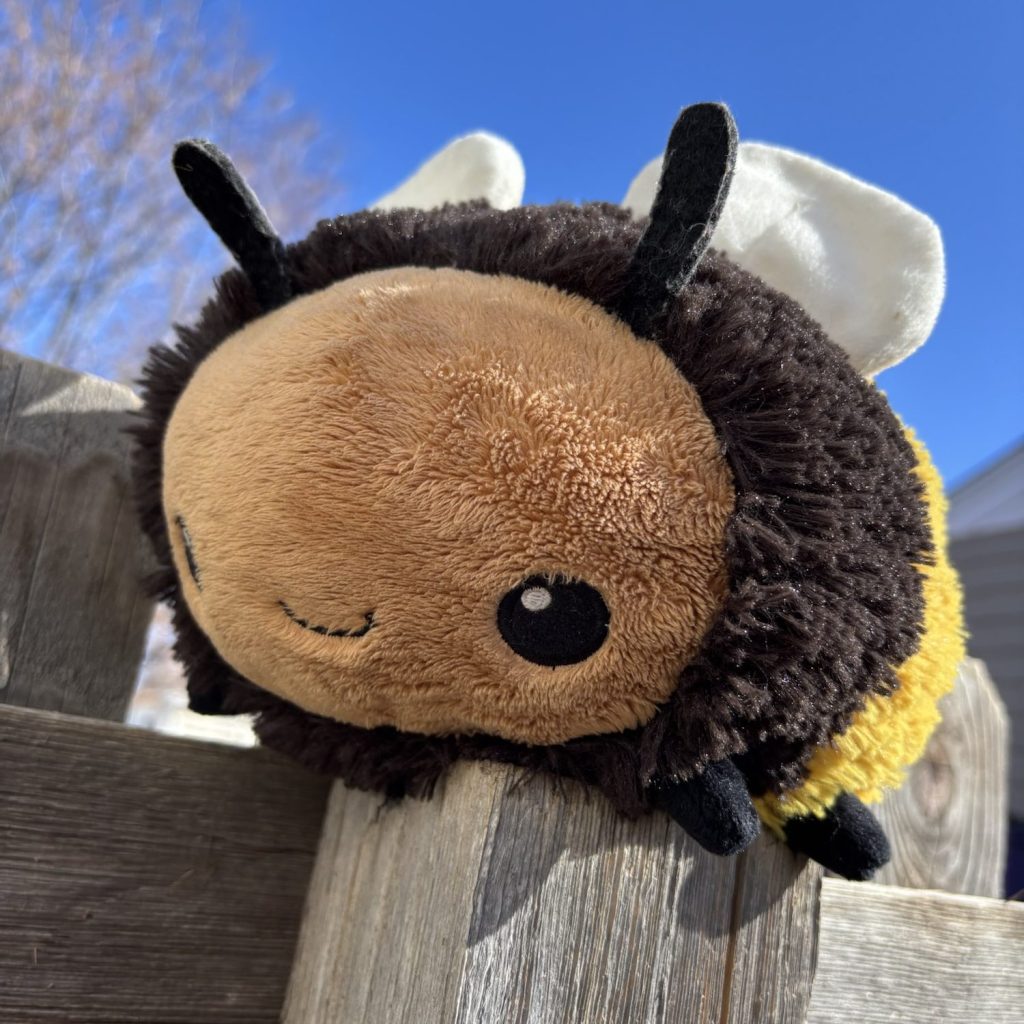
Plush "bumblecat" sitting on a wooden fence, which was the inspiration for my short story.
Giant plush bumblebee on a fence

In July 2018, almost eight years ago, I finished writing the first final draft of one of my favorite stories, Bumblecat. I submit it to a journal and was rejected three months later. The timing worked out so that I could then submit to one of my favorite publications, Glimmer Train. They had a call out for their final issue, and I dreamed of being included. They also rejected me. Undaunted, I sent it to an online publication where I got my first ever negative rejection. I had paid for feedback from the staff reader. That was a mistake.

If this is sci-fi, it deosn’t pass the test of plausible science. If it’s an allegory, I’m not sure what of.

The opinion of this single person, who deosn’t even consider my feedback worthy of spellcheck and ends sentences with prepositions, was enough to make me quit. I mothballed Bumblecat.

Six years later, I was a different writer. I had three publications under my belt. I was a different person. My ten-year-old had grown old enough to drive. I had a longer view of motherhood. I had just ended my 20-year career supporting the Federal Government. My life experience meant I knew behind the scenes workings of scientific grants and technology commercialization. I knew how different facets of intelligence — scientific versus political — can conflict. I knew that being smart and being successful were not the same. I knew the conflicts between ambition and altruism. I was in an altogether better life place to tell the story of Bumblecat.

My first task in 2024, as a fulltime writer, was to rewrite Bumblecat, and develop a plan. I would submit to all the big magazines: the ones that won awards. An acceptance there would jumpstart my writing journey. Bumblecat got rejected six times in four months.

While “Bumblecat” isn’t quite right for us, many on our staff were impressed with your writing, and your submission merited additional consideration before we reached our final decision

I found this to be such a unique story!

I agreed with these rejections. It was good writing and a unique story, but why did everyone say it wasn’t a fit? Having exhausted my list of elite publications, I took the summer off from submitting.

My daughter is the muse for Bumblecat. I have this big puffy stuffed animal bumblebee. When she was little, she and I were lounging in my bed and one of us, I don’t know who, came up with this idea that my huge bee was a bumblecat. The story’s opening scene is an homage to that goofy mother/daughter chat.

During my summer submission hiatus, my family traveled the East Coast and Midwest searching for the perfect colleges and universities for my now seventeen-year-old kiddo to apply. Where would she go for her next life adventure? We looked at elite colleges, and they all felt icky. We looked at big state colleges, and some of them felt good, but not all of them. We looked at small business schools, and some of them felt good too. We made her application list not based on prestige, but based on where she thought she would fit. My daughter continues to teach me.

My first fiction publication was with Luna Station Quarterly (LSQ). They published Grork Dentist in 2019. I’ve been a loyal subscriber ever since. I love that they publish both online and on paper. I love that they focus on women writers. I’ve lurked in the editor’s Patreon long enough to be impressed with not just the stories Jennifer Lyn Parsons publishes, but how she’s handled the advent of AI, how she protects her writers, protects her own work, and has curated her publication. Maybe, I thought, she might appreciate some of the quirkier aspects of Bumblecat. My story is about a working mom balancing her family and her dreams while battling the establishment. Distilled down it’s about women experiencing the female condition. Could it be a perfect fit for LSQ? When they opened for submissions, I sent in my story. I got the best response.

LSQ would love to publish Bumblecat

I would love to announce that LSQ has published Bumblecat. I’m delighted to be back home between it’s covers and can’t wait to hear what you all think about the story, the characters, and the bumblecats.

The publication is available in a variety of electronic formats and in print. Be sure to check out the beautiful artwork by Sve Yurchenko, a Ukrainian artist, on the cover. I love it. It’s such a great match for Bumblecat. Read a few of the stories. Let me know which ones you love. I hope mine is one of them.

An Extremely Belated Celebration

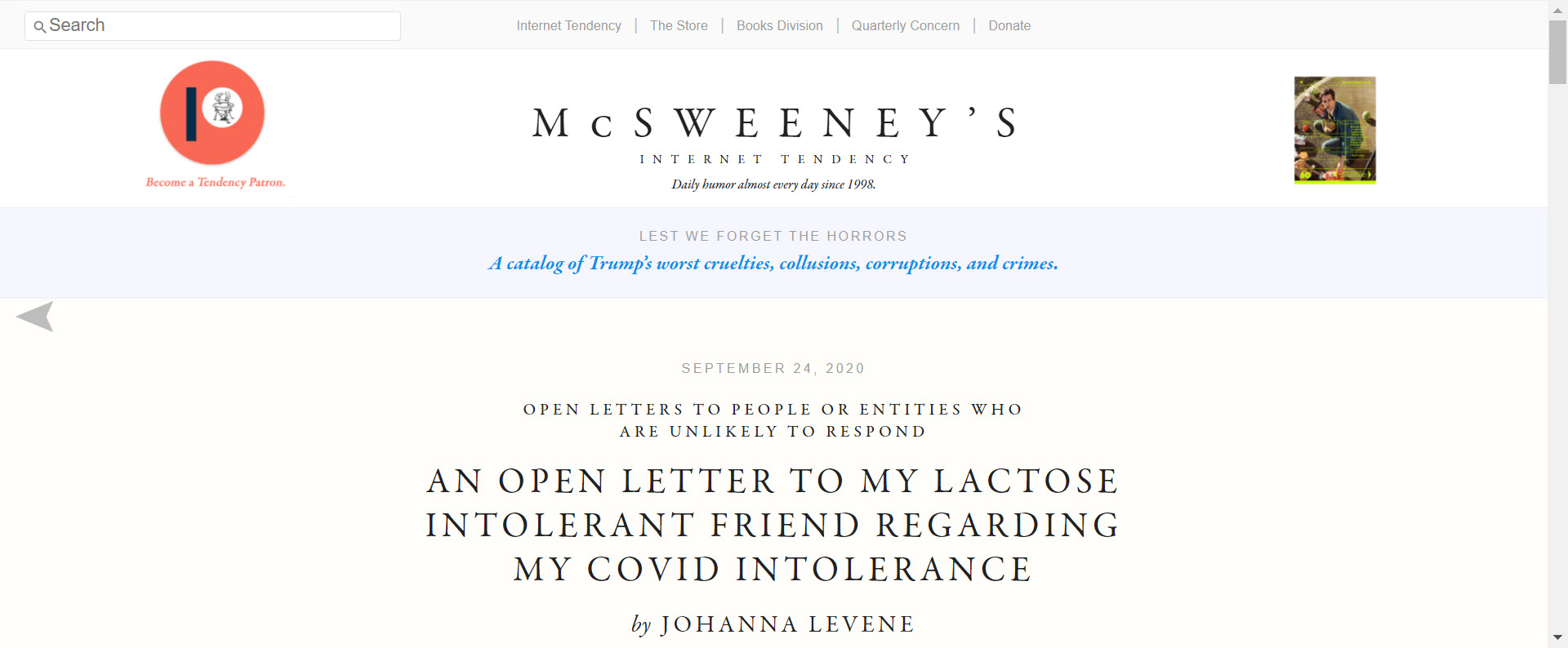
2020 was a crazy year. In the midst of a global pandemic, I had a really good thing happen. But I never shared the really good thing on Afthead, because Afthead was a public place and the really good thing wasn’t necessarily something I wanted people to know about. Okay, I didn’t want my friends to know, because I was extremely frustrated with some of their COVID protocols, or lack thereof. To cope I wrote a satire piece about them and it got published in McSweeney’s Internet Tendency. This publication is a big deal in the humor world. McSweeney’s acceptance rate hovers right around 1%. It’s like getting into the Stanford-Harvard of magazines. I highly recommend checking it out.

Somehow, the idea of reaching out to all my friends whose food intolerances I’d fastidiously honored in the past and telling them that I was publicly mocking them seemed wrong. Also, I wasn’t in a good place with many of them when it was published. I was busy being lonely and angry while they were out camping without me, because I wanted to do ridiculous things like wear a mask. Or their kids were doing remote school together because it was so hard on them.

Four years in the future, several of those people are my friends again (and the ones who aren’t never really were). Most of us have talked about how we were all doing the best we could during those really hard times, and have forgiven each other. Or we just let it go.

But I still haven’t mentioned to them about the most popular thing I’ve ever written. I didn’t tell them that afterwards I got interviewed by The Writer magazine, featured in an article about getting COVID-19 stories published. I didn’t share all the emails I got from strangers telling me how they were struggling too. I didn’t forward the funny comment from Facebook, “Licorice has gluten?” I didn’t want to stretch those strained relationships any farther.

So why post this now? Why not just let the happiness stay quarantined? A couple of things have changed. First, I realized that the friends I was frustrated with don’t read this blog. They don’t see my words. Unless I print this out and shove it under their windshield wipers they won’t know. Also, I did tell lots of people. Work friends got a link. Family got a link. People who I know didn’t follow my exact protocols read it and enjoyed it. Finally, I’ve told everyone I’m taking a year off to write. If I’m a writer, I want to celebrate my writing successes. I decided four years was enough space. It’s okay to let out a little celebratory yay about this piece and say I’m proud of it.

The magical thing about this piece was that it all came out in a whoosh. Normally my writing has tens of drafts littering a piece-specific folder on my computer. (Even this post has 22 revisions!) For my McSweeney’s piece there’s not a single draft on my computer. I wrote it, edited it, and published it from one file. I remember showering and furiously crafting this letter I would send to my friends. I didn’t write a word until I had all the biting phrases worked out. It was like I’d birthed the story fully formed out of my fingertips. Such magic should be acknowledged.

The last amazing thing about this piece? I was in the middle of graduate school when I wrote it. I hadn’t had a creative urge since March 13, 2020 when we all got sent home from work and school to survive the end of the world. I was taking my last two master’s level classes before my capstone. I was working full time and helping my kid do school from home. I was terrified for my parent’s lives, and my support system was fractured and frayed because of my community’s disagreement on the pandemic. It was a horrible, horrible time, and I dealt with it by producing witty, poignant, biting satire. Looking back, I am in awe of myself.

If you want to take a trip back in time and see how September of 2020 felt, now’s your chance. It was a time before COVID vaccinations. We were on the cusp of a huge winter surge. 700 people were dying a day. Somehow I coped by crafting words like this:

People can have COVID and not know it, kind of like that irresponsible room mom last Halloween that didn’t know licorice has gluten. Mistakes happen. You might be laughing and shouting germs all over and never know until someone gets sick. Imagine how embarrassed you’d feel if you accidentally killed my parents. They say hi by the way.

The little masterpiece is still online at McSweeney’s if you feel like taking a trip down that horrific memory lane. Me? I’m going to go reread the acceptance note. It’s glorious.

Thanks for the submission. This is great. We will take it! It should run in the next few weeks. Would you mind sending me a photo and bio for your author profile? 

Would I mind? Uh, heck no! Yeah, I have an author profile on McSweeney’s too. Pretty cool, even four years later.

Twas the night before publication…

Twas the night before publication, and all through the house not a creature was stirring except me because gosh darn it, holy moly, gee whiz my first short story is getting published tomorrow!  Monday, June 3rd is publication day.  After a rough few years of submitting and being rejected, then completely quitting for a bit, I’ve had a run of acceptances.  (Is two a run?  I feel like it is.)  My first creative essay was published online April 20th and now my first fiction story will come out tomorrow.  Tomorrow, tomorrow, I love ya, tomorrow….

Grork Dentist will be published by Luna Station Quarterly, a magazine in their tenth year of publication.  I’ve loved Luna Station Quarterly since I first came across Holly Lyn Walrath’s story The Joy of Baking.  It’s a magazine with a cool mission: publishing speculative fiction by women-identified writers.  I love that they do a print and online publication (I’ve got four print copies arriving Tuesday from Amazon, thank you very much.)  It’s easy to share online publications with friends and family, but likewise really special to have a print copy of your very own story to hold, and smell, and sleep with, and carry in your purse everywhere, and give to your mom, and accidentally leave at your dentist office and… and…. I might need to order more copies.

The other cool thing?  I got to write my very own real live author bio.  I mean, does it get any more official than that?  My full bio is online and a shortened version will appear with my story.  Nothing makes you feel more like a real honest to goodness writer than a bio.  That is, not until tomorrow when I see my story.  I bet that will feel even better.

It’s funny, because I spend a lot of time with the Twitter writing community.  (Too much time, but hey, it got me my first publication.)  I’ve read how getting your story published doesn’t change anything.  My expectations will just get adjusted and I’ll want bigger and better things.  I must disagree.  For me, getting my first story published means the world.  As great as this story’s rejections were from high quality magazines — “We loved this story’s delightfully ridiculous concept” and “there’s some good writing here” — nothing equaled the joy of “We would like to publish your story, “Grork Dentist”, in the next issue of Luna Station Quarterly. Thank you for submitting!”  Getting a story you are proud of accepted into a journal you love is a very special feeling.  I’m now no longer afraid of calling myself a writer, and the publication has made me believe that my stories are worth writing and worth being read.  That feeds my writing soul.

Tomorrow I’m going to be refreshing my browser like an idiot waiting for the cover image to change and my story to show up.  Until then, I’ll be like a kid waiting for Santa, the Tooth Fairy, and the Easter Bunny to all show up overnight and bring me the best present imaginable.  Happy publication eve to all, and to all a good night.

Acceptance

LeveneJohanna_0162

I’ve been sending little stories of mine off to journals to be read, judged, and rejected.  From 2015 to 2017 I had one story rejected four times.  Then last year I got brave.  I threw three stories to the winds and let the rejections flow: ten of them.  I worked hard to perfect those little tales.  My writing group read them and gave feedback.  My mom read them and gave feedback.  My husband read them, corrected my grammar, and disliked them.  I even donated enough money to a new journal so a real live editor could critique my story.  I worked and tweaked, and while the rejections kept coming they started to give me hope.

My favorite rejection?  One that ended, “We loved this story’s delightfully ridiculous concept, but we felt the story didn’t have enough conflict to support it through the middle and ending.”  Um, the words love and this story appear together in this delightful rejection.  It almost feels like an acceptance….almost.  Another was rejected the day before they sent out the list of anthology finalists.  They said, “…there’s some nice writing in the story, but unfortunately we felt it just wasn’t quite right for the collection.”  Nice writing?  That’s enough to make me brave enough to submit somewhere else, and to watch this journal’s calendar carefully so I can submit to them again.

I know that ten rejections in a year is nothing.  One of my favorite blogs, Rejectomancy,  has a whole formula for calculating your power as a rejectomancer.  Aeryn, the blog’s author, revels in his rejections, having just tallied his 300th rejection.  Three hundred.  I love Aeryn’s blog because it’s really hard for me to get all freaked out about 10 rejections when he’s statistically analyzing three hundred.  Also, I’m not just a writer but also a geeky spreadsheet loving engineer, so recording and analyzing rejections is a form of comfort for me.  Another comfort?  Watching your Rejectomancy score increase as you get different types of rejections.  By the end of 2018 I was at 20 points: a glass level rejectomancer aiming for ceramic.  (Really, this system is so amazingly nerdy!)

2019 hit and I was ready to submit like mad.  Armed with my positive feedback and desire to rise through the Rejectomancy ranks, on a whim, I submit to a journal I had not researched that promised personalized feedback.  The story I sent had already received one lovely personalized rejection – the nice writing one – and one form rejection.  It was a piece I loved and felt confident about.  The day after submission I was rejected with a full page of detailed information about how horrible my story was, what a terrible writer I am, how the concept was interesting but horribly executed, and the ending sucked.  It would have been kinder and more succinct to reply, “You are a terrible writer with no concept of story.  Your words caused my eyes to bleed.  Cut your hands off so your tales never torture again.”

So I quit writing.  I quit submitting.  I quit my writers group.  I quit.  The end.  Eleven rejections was all I’d ever see.  It was one thing to get rejected with kind words and another to have strangers rip me to shreds.  Writing wasn’t worth it.

Except, I didn’t really.  In Bird by Bird, Anne Lamont talks about writing presents, “Twice now I have written books that began as presents to people I loved who were going to die.”  The concept of writing presents speaks to me, drives my desire to finish my novels, and made me write a love letter to myself.  I wasn’t dying, but my hope and dreams of being published were dying, so when I saw a tweet for the 1000 Love, You Letter’s project I started to write.

The concept is not really me.  I am not a self-love essay writing kind of gal.  I’m an alien dentist, fisherman of children’s souls, bumblecat type of writer.  I’ve got stories about convicts puking, the end of the world, and heaven being destroyed by bureaucracy, but my dying craft cried for a story, a goodbye, a last hurrah, so I wrote myself a love letter.  No one read it but me.  No one edited it.  No one even knew it existed.  I wasn’t going to send it, but my tribute required a submission, so I sent off my letter.

The submission’s initial response is what you would expect from a project collecting letters from women writing love letters to themselves.  “This is a beautiful letter and we’re thankful for you trusting us to share it with the world.”  Sweet, and what you’d want every vulnerable woman essayist to hear.  Writing a love letter to yourself is an embarrassing emotional effort, and even more embarrassing knowing that others are going to read what you wrote.  Urban Ivy, the publisher, does a wonderful job of making the brave women who submit to them feel valued and that kindness was a salve to my broken writer’s heart.

Before I quit writing, I dreamed of seeing my story in print on a piece of paper.  Not on a website, but on a tangible page where I could run my finger over the text.  Something that I could put on a bookshelf and read until it was tattered.  Something that, when I was old, would smell like old paper and ink.  My submissions were brave and bold, targeting the journals that still print and accept less than 0.5% of the stories they receive.  I had a plan to move onto online journals once I’d exhausted the list of print publications.

The submission response from the 1,000 Love, You Letter project also said, “We will be in touch by March 15 to share which letters will be published in the Love, You book and on our social media!”  Even though I had quit writing, this little glow of hope that I find hard to extinguish grew as I watched the social media announcements about the project.

On International Woman’s Day, Friday March 8th, a message in my inbox was titled, “Your Love, You letter has been selected!”  I was stuck in a traffic jam on the highway so checked my email. (Totally unsafe. Never do this.)  I didn’t want to read the email on the road, but my glow of hope spread during the 20 minutes it took me to get to work.  My dream of publication might be coming true.  I wondered if there was going to be a request to send my bank account information to a prince in Nigeria before they published.   Then I yelled at myself to just be happy for once and not think how this could go wrong.  I thought about who I wanted to tell and how.  Once I parked, I reopened my email and read, “We’re excited to share that your letter has been selected to be featured in the Love You Book which is set to publish this Fall and will also appear on the 1000 Love You Letter website within the next few weeks.”

I burst into tears.  Happy tears.  Accomplishment tears.  Dream tears.  Tears I never thought I’d be able to shed but always wanted to shed.  My present to myself was going to be published, and not just published, but published in a book.  I unquit writing right there and then.

A week later I’m stalking the publisher, Urban Ivy, the letters that are already being published online, and the Instagram and Twitter feeds about the project.  I’m liking and retweeting and anxiously awaiting the next steps.  10 points were added to my rejectomancer score jolting me right past the ceramic level and on my way to denim.  My confidence restored, I resubmit my one-day-rejection story to a journal I love in hopes that it will find a home there, or at least some kind words.  I returned to my writing group, tail between my legs, and told them of my acceptance and thanked them for their kind words that I had ignored while I was feeling sorry for myself.  Because they are awesome people, and writers too, they welcomed me back.  Slowly I’ve been telling family and friends, while savoring my happiness.

I wish this fairy tale ending on everyone.  I hope that every low point is offset with a high, but I know that this is a wonderful, beautiful anomaly.  Unquit writer me is going to  continue to have mean things said about her writing.  If I’m really successful, people will rant about me the way I rant about Neal Stephenson and Paolo Bacigalupi; I cannot stand the famous, successful, prizewinning works they produce.  I have to get thicker skin and grow from these experiences: both the bad one and the good one.

The primary wisdom I gained from this came from my good friend Lew Gibb, part of my amazing writing group, who said about my mean rejection, “My wife and I have a great saying that works in these types of situations: ‘If someone honks at you for more than a second, it’s not about you.’ Everyone’s dealing with their own shit. It’s obvious, since they did the literary equivalent of a three second honk, that your reviewer allowed their shit to overflow into your story.”  He’s right.  I need to be strong enough to tune out the long honks.  I need to value the cheers of myself and my friends more than nasty words generated in a single thoughtless day.  I can’t just write love letters when I’m down.  I want to remember that everything I write a present, even knowing that there will always be critics who despise my gift.

But guess what?  I’m going to be published!  Acceptance at last!  I cannot wait to hold this book.  I’ll need at least two copies: one to cherish and one to get spotty with I’m-holding-my-story tears.
Rejection Therapy via Twitter

I’ve been dipping my toe into the very scary world of publishing, because writing is a funny thing.  The more I meet other writers, both online and in person, the more I realize we are all different and all motivated by different things.  (Not shocking, since we are all people, who are inherently different and motivated by different things.)  In my heart of hearts, I put words on paper so other people can experience the stories and worlds I create.  It turns out that other writers are happy to write just for the process of writing.  This I find fascinating, even while I’m a little jealous, and a baffled by their opinion.

For the longest time — going on 3 years folks — this blog has served as a way to get my stuff read, but I’ve always known there were other works I wanted to get out there:  the novel and a half I have moldering in my desk drawer; the four short stories in different phases of editing.  I also know that I have a leaning toward traditional publishing.  Even having heard all the horror stories I am a firm believer in the power of collaboration.  In my dreams, I want an experienced team of publishing people behind me and my books.  (Again, guess what?  Not all writers feel this way.  Some are passionate about publishing independently, and I watch their process eagerly, because as I learn I might change my mind.)

Therefore, to achieve my current goals, I need to build a portfolio of published works.  I need to prove to myself and to editors, agents and publishing houses that what I write is worth reading.  Many of these path-forward insights have come though:

  • Reading books (Stephen King’s On Writing is still my favorite);
  • Agent blogs and twitter feeds (I have learned so much from Mary C. Moore’s blog );
  • Author’s sites and twitter feeds (Represented by Mary and Kimberley Cameron & AssociatesRati Mehrotra has a great WordPress blog and her first novel will be out January of 2018.  I’m loving watching her go through the publishing process  I’ve also learned from her, and have mined her past posts for potential places to target my short stories.)

To build my portfolio, I’ve started submitting my short stories to journals, and I’m starting to amass rejections.  (Four so far.)  I found out about my most recent submission site, PodCastle, through Rati’s blog.  In September they were accepting submissions for their Artemis Rising event which celebrates women identified fantasy writers, so I took a deep breath, did some wordsmithing (my story was 1700 words and they wanted at least 2000) and I submit right before the deadline.

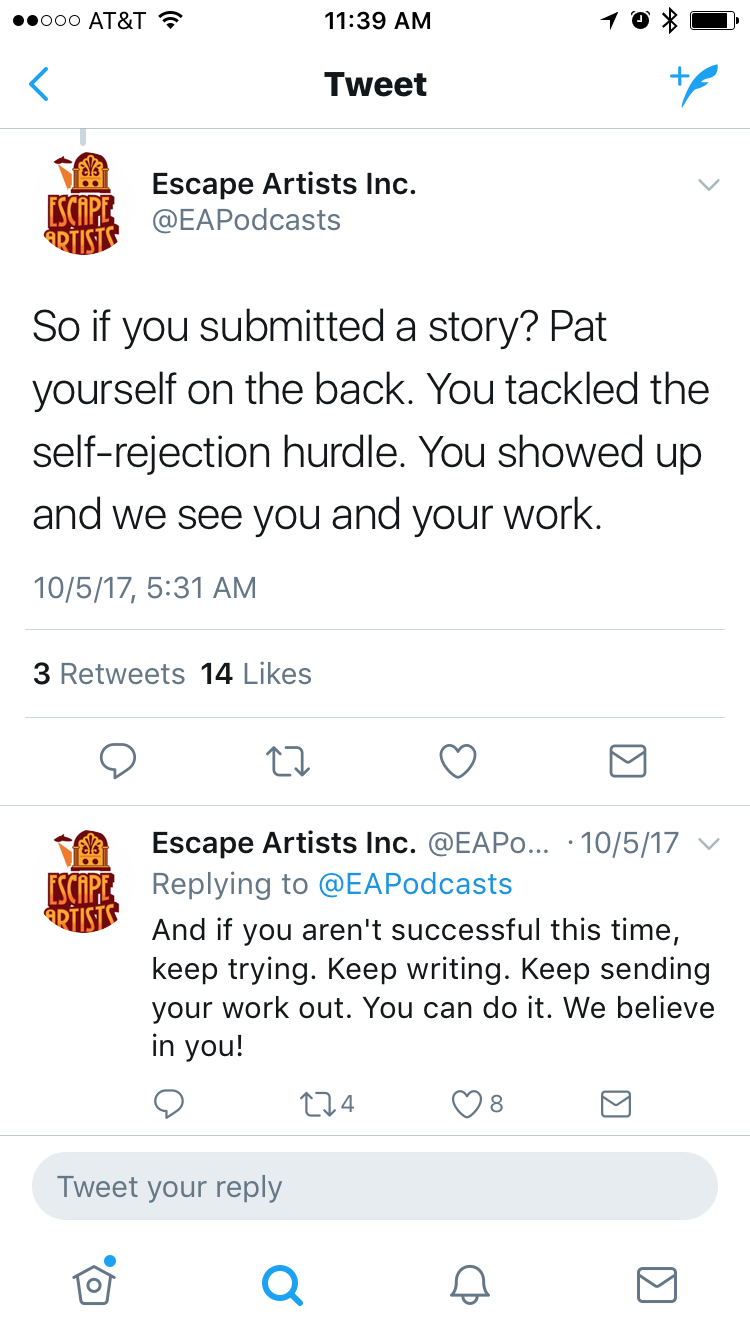
Then Twitter provided me with some really amazing facts, because you see, I follow PodCastle and their parent organization Escape Artists Inc.  Here’s what I learned about the Artemis Rising submission process:

Whoa, I’ve got to say, I love this type of information, and appreciate that Escape Artists provided it.  It’s way easier to look at stats like this and accept that your story might be good, but still be rejected.  Then layer on that for PodCastle, which I submit to, there were over 200 submissions for 4 fantasy slots: data also reported on Twitter. My odds abruptly went down to a less than 2% chance of acceptance. Then four days after I submit, my odds went down to 0% with a rejection.

“It’s an interesting story, but it didn’t quite come together for us and we’ve decided to pass on it.”

But that’s a fair rejection.  I dumped 300 new words into what was a lean and mean story to try and make it meet the word-count requirements of Artemis Rising.  In hindsight —  now that it has been rejected — I wish I hadn’t submitted.  I wish I would have waited until PodCastle opened back up for normal submissions, so I could have submitted the shorter version of the story I worked really hard to tune and tone.  But the twitter thread from Artemis Rising continued.

Isn’t that sweet of them.  They made me proud of me, and inspired me.  And you know what? The rejection note continued too:

“We appreciate your interest in our podcast; thanks again for giving us the chance to look at your story.”

That’s when my epiphany happened. Someone read my story. Sure, they read my story and decided that it wasn’t in the top 2%, but they read it. And if you remember way back at the top, I said, “I put words on paper so other people can experience the stories and worlds I create.” Well, someone experienced my story and said it was interesting. Sure, it wasn’t the most interesting, but that’s okay. My first goal is to get a rejection that has some specific direction to how I can improve my work. My next goal is to get an acceptance. But the only way either of those will happen is if I keep letting people read my stories.  Which is great.  Because I want people to read my stories.  So I’ll keep submitting and editing and hoping my work finds a good fit.

(Of course, I’m not a total Pollyanna.  The rejections hurt, and it would be so much better if I got published, because then even MORE people will get to read my stories, but one step at a time.  This writing stuff is a process, and while I #amwriting, I also #amlearning, and that’s fun too.)

Gold Star – 100%

I am a grown up.  My life is measured in vague shades of grey.  At work, the exceptional ratings are saved for the top 5-10% and I’m lucky to see one every 5 years.  (And due to recent changes, I’m certain to not see an exceptional anytime soon.)

As a parent, it turns out there is no “mom of the year” award.  Even if there was, I wouldn’t win it.  While I’d score high marks on basic measures like my daughter being alive and her not getting called into the principal’s office, I would get zero points on unexpected top-mom qualities like “make myself a priority”.  I need to lose 10 pounds and am too frequently unshowered in public.  (True story:  I picked up my daughter braless the other day.  I mean I had a shirt, a sweatshirt and a coat on, but no way do free breasts get you mom-award points.)

Then there is my writing persona.  My short story came back last week with a kind but brief rejection: “We appreciate the chance to read it. Unfortunately, the piece is not for us. ”  I ignored the tiny voice in my head that said, they seem nice, so reply back and see if they know who it IS for.  That would be helpful.  Instead I did what I’m supposed to do:  submit again to a new journal and not be disgruntled.  I’m trying, but so far my publishing career score would be a 0%.

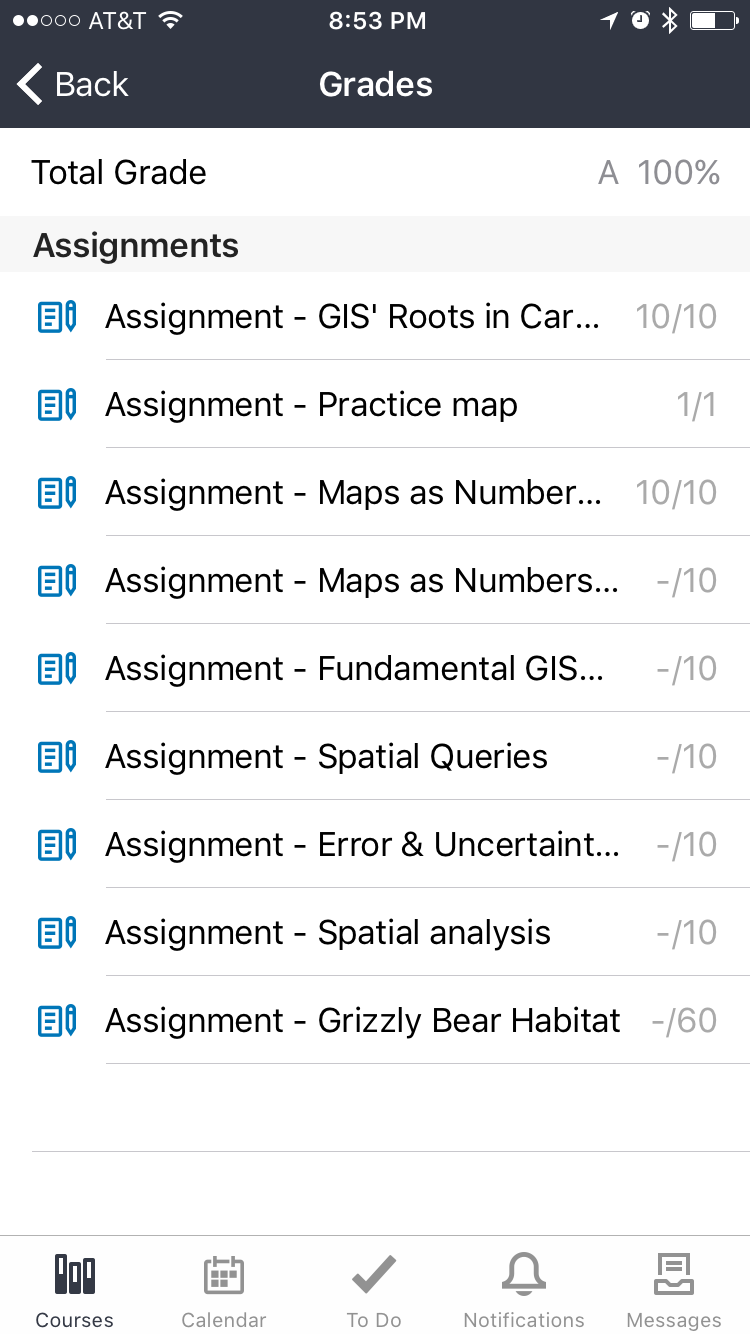
Then there’s graduate school.  Given the vague I’m doing okay, or at least better than nothing scores in the rest of my life, I probably shouldn’t have been surprised when my first homework assignment grade gave me a thrill.  I mean, it was just 1 out of 1 – I just had to turn the dumb thing in – but I got 100%.  Now three assignments in my grade is 21/21, still 100%.  My homework grade is perfect.  I have an app on my phone for school, and I can pull up my class for anyone to see and show them that I am perfect at something.  (No, I do not show anyone my perfect grade.  Okay, except my husband, and kid, and a couple of friends at work.  Well, and now all of you readers, but that’s it so far.)

A friend told me I should print my homework assignments out and put them on the fridge, just like I would do with my daughter’s good grades.  I haven’t gone that far yet, but I am wearing my little virtual gold star around proudly.  Only six assignments left.  Gotta go finish my reading, so I don’t break my perfect streak.  100%, just in case you missed it.

How do I know my genre?!?!

So, a L-O-N-G time ago I posted about the novel I’d finished writing, and had this super awesome list of things I was going to do next.  Then life happened and the list items didn’t all ticked off.  Sometimes I find I need a deadline or a reason to motivate me, so I signed up for a Writer’s Digest Bootcamp to have my first ten pages and query letter critiqued by an agent.

The first thing I learned, that got my heart pounding, was that I had to define my genre.   This was #6 on my list from August.   Even back then I knew I couldn’t pick an agent until I completed this step, because agents specialize in certain genres, and I needed to pick an agent to review the first 10 pages of my novel and my query letter.  Oh no.

I’d heard lots of advice.  Figure out the genre of comparable novels and that will tell you your genre.  Okay, I’ve got a list of comparable novels, but my google searches of “Dark Tower genre” led to no useful results.  I looked on Amazon, but there are so many words on an Amazon page that I wasn’t sure what the genre was, because there was nothing that said “Hey newbie writer, here’s the genre!”

However, after searching like crazy, and even buying an awesome poster from Pop Chart Lab on “A Plotting of Fiction Genres” and hanging it up in my study – looking gorgeous but not helpful – I finally found a resource that makes sense to me: The Book Country Genre Map.  This is an amazing, AMAZING site.  I was quickly able to drill down into both Science Fiction and Fantasy and see how each genre was defined and what subgenres exist.  I’ve pegged my novel as a contemporary fantasy subgenre (I think), but definitely in the genre of fantasy.  Now, I may be totally wrong, but at least now I have the vocabulary I need so when I look at the Amazon site and see  Books > Science Fiction & Fantasy > Fantasy > Epic under The Gunslinger, by Stephen King, I can translate it to Genre: Epic Fantasy.  Sadly, I put this as one of my comparable titles, but I’m not epic fantasy.  Thankfully this boot camp is a chance for me to make mistakes and learn from them so when I go to query agents with a completed novel I’ll know better.

I have to admit, I’m loving this aspect of moving my book to the next stage.  There is so much about this publishing world that I don’t know and it’s fascinating learning the lingo, the rules and the processes.  It’s so different than my day job, but there are really interesting parallels.

Item #6?  Done, and will help me finish #5, #7, and #8!  Now I really need to get motivated to make a big push on the second draft so I can have someone other than me read this thing!


Dream or Prophesy?

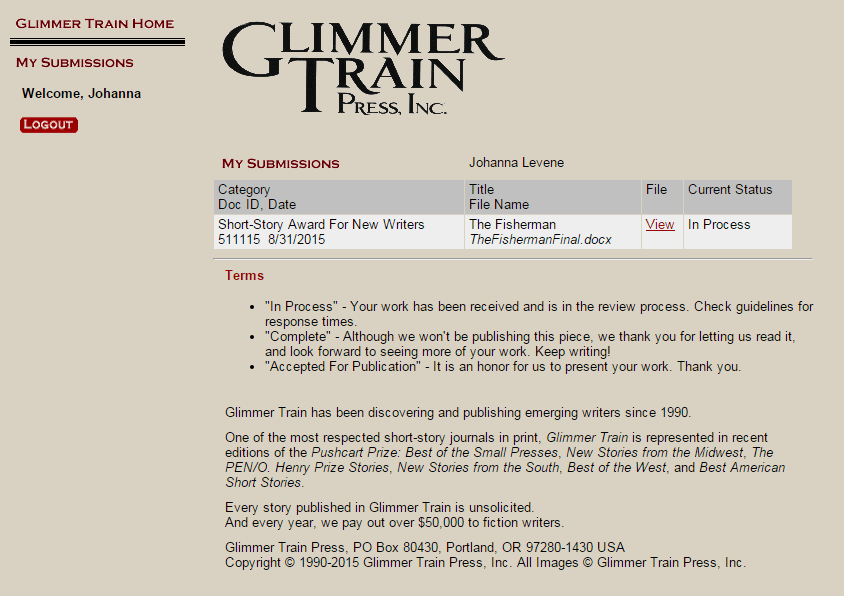
On September 13th I had a dream.  (Yes, I know, I hate hearing about other people’s dreams too.  There’s a point.  I’ll be quick.)  I’m holding in my hands a book, well, not quite a book.  It’s papers with book-like organization and book like shape and it has my story in it and pictures of me.  Not quite my story, there are differences, but my story and weird pictures I don’t ever remember being taken, but they are of me.  I flip through the unbound pages to the cover.  Glimmer Train.  “Oh,” a woman’s voice says, “You aren’t supposed to see that yet.”  The story is The Fisherman, which I submit to Glimmer Train for their Short Story Award for New Writers award the end of August.  In my dream I saw my story in the magazine.

I have read countless articles and books on writing.  Get it out there, they all say.  Just keep submitting, they all say.  Then they always say, “I didn’t even remember I had such-and-such story out there, when I found out I got published.”  Okay, I know I’m a newbie, and I know this is my first submission but WHAT?!?!  I’m going crazy here.  I have a full time job, I’m a mom, I’m fostering two kittens from the animal shelter, I’m coaching my daughter’s soccer team and I still check my e-mail several times a day to see if I’ve heard from Glimmer Train yet.  Are these other writers beings with hearts and souls of stone, or am I just nuts?

It’s kind of fun.  The site says, “Winners will be contacted directly the week before the public announcement in our bulletins” and the bulletin is due out November 1st so the longer I don’t hear something the more giddy and butterfly-stomachy I feel.  Sixteen days….but if I don’t hear in nine days is that good news by default?  *flutter flutter*  Then I tell myself, “They just moved to a new computer system.  You know how that goes.  It’s what you do for a living.  They are probably just doing a batch update in the old system and that’s why you don’t know yet.”  *flutter flutter*

I’m trying to keep my rose colored glasses on.  I know the odds are slim.  I know they get tons of submissions.  I know no one gets published on their first submission.  Why did I have to be the one who submit a story when they got a new computer system?  But I haven’t heard anything yet so the excitement builds.

They probably just lost it.  It’s stuck in some bit or byte and they don’t even know it’s there.  November 1st will come and go and I won’t hear anything, and I’ll miss my chance to submit to the Writer’s Digest competition I’m eyeing.  I’ll be that awkward whiny person who e-mails them, “Uh, did you ever read my story?”

Gasp.  Maybe they like it.  Maybe I’ll get published.  Maybe it really is good.  I think it’s good….sometimes.

It’s like a writer’s Christmas Eve, but this time Santa really might not come, or he might bring me coal.  Do you hear the reindeer’s hooves?

I just checked.  Still no e-mail.  Still no update on my submission status.  I’m still In Process – Your work has been received and is in the review process. Check guidelines for response times.  Of course the guidelines are gone, because of the new system.  This is like every user I’ve ever programmed for paying me back for moving stuff they want to find on a website.  When will I move to Complete or *flutter flutter* Accepted for Publication?

Nine more days, or sixteen….

*flutter flutter*

My Soul is Tired

Eighteen days ago my world turned upside down.  I figured it would be no big deal to bring tiny kittens into my house and foster them.  I’d feed them, clean their litter box, give them fresh water and continue on with my life as normal.  No big deal.

Wrong.

Three dead kittens later, eye drops, antibiotics, steam showers, and subcutaneous fluids have eaten up every spare moment I have and several spare moments that I don’t have.  What the heck was I thinking?  The care of these kittens has not just drained my energy, it has drained my soul, and this is a problem.

It’s a problem because tomorrow is the day.  It’s the day I have planned for eight weeks.  The day to break open my novel and read it for the first time.  I should be excited and jittery, but I’m exhausted.  My wonder has gone the way of dead kittens, and that is not a happy place.

Do I seize the time I’ve carved for myself and read?  Do I wait for the next free moment, even if it means waiting until November?

Fostering was supposed to be fun and a great life experience.  Who knew these tiny cats were so fragile?  I haven’t felt this raw since the pediatrician uttered the words “failure to thrive” over my tiny daughter’s body.  I was not a good mother to a newborn human.  I am not a good mother to cat newborns either.  They consume every ounce of me, these tiny new beings.  I give more than I have and then I give more.

Tomorrow.  Do I read?  Do I not?  This too is supposed to be fun.  The anticipation of the first read.  The triumph or the tragedy when the last page is turned.

What to do….

Periodic Publishing Posts – Self Publishing?

I’m 6 weeks into an 8 week hiatus from my novel, Hallelujah, and have been working through a list of to-do items prepping me to get my book published.  The last couple of weeks have completely flummoxed me.  I went into this wanting to publish traditionally.  I wanted to have Simon & Schuster, HarperCollins or Penguin Random House on the spine.  (Uh, Penguin and Random House merged?  I had no idea.)  A couple of conversations with some friends of friends has made me wonder what my next step really is.

Conversation #1 – Founder of a self-publishing firm

A dear friend of mine suggested I spend my Sunday morning walking with Polly Letofsky.  Thankfully that’s an organized event anyone can join every Sunday, so it wasn’t a weird idea.  My friend knew that Polly had written a book about her experience walking around the world and she thought Polly might have some ideas about how to get my book published.  What she didn’t know was that Polly had moved on to starting a self-publishing project management and consulting firm, My Word! Publishing.

Polly had all kinds of information about what she does and how her company works.  She encouraged me to self-publish.  She threw around a lot of words I didn’t understand about publishing and the process and encouraged me to contact her for a free evaluation.  Basically her company puts together a publishing team for you: editors, marketing people, writing coaches, and whatever else you need.  Polly told me my first step was to start my own company, which I would later use to publish my book.  This was all fascinating and overwhelming.  Here’s what I took out of my conversation with her:

  1. If you want to make money on your book, you make much less per book with a traditional publication (like $1/book) versus self publishing ($12/book).
  2. An average book sells 2,500 copies.  An average self published book sells 250.
  3. You need to understand your own goals for publishing.

The first two bullets are a math problem.  Jojo sells 2500 copies of her first book and makes $1/book.  Anna sells 250 copies of her book for $12/book.  Who made the most money publishing her book?  If you play the averages, self-publishing wins, but by only $500.  However, this is where bullet number 3 comes in.

Once I had time to think I realized that my goal is not to make lots of money.  My goal is to get lots of people to read my book.  In my dreamy dream world I want to publish a book that people want to read, which is measured by them buying lots of books.

In my limited knowledge of how all this works, I didn’t even consider self-publishing because I do not believe that I could write a book lots of people want to read by myself.  People are not interested in a book with grammar errors, writing issues, and juvenile construction.  I know I need a whole team of people around me to publish a quality book and that meant traditional publishing.  Polly opened my eyes to the fact that the consolidation of the publishing houses means that there are lots of publishing people out there waiting to support self-publishers.  Once I read my book and determine if I want to go forward with it I’ll meet with her and see how her process works.  More on that here when the meeting happens

Conversation #2 – A self-published author

Jamie Ferguson is a friend of a friend and she published With Perfect Clarity in 2013.  I read her book and we’ve had a couple of e-mail conversations back and forth.  Hopefully we can meet in person and chat about her process in detail, but what I found out from her was that she also self-published through her company, Blackbird Publishing.

When I found all this out I did a double take.  This idea of starting your own company to publish a book seemed crazy when Polly mentioned it to me, and here I already had a data point telling me that was what people really did.  Jamie had editors tell her that the book was good, but would be hard to publish traditionally and an agent who was interested, but wanted her to make big changes, so she self published.

Both these conversations were interesting, and at least opened my eyes to what self-publishing means.  I’m not as against that direction as I was, but I’m a little overwhelmed by the thought that I have to write a book and then find a team, and then pay the team to edit, market and publish my book.  (If the averages work out I have $500 I could use to pay all those people and end up cost neutral.)  The flip side is to continue to try the traditional route.  I’m torn, but I don’t know enough yet.  My next steps are to learn more by meeting with Polly and Jamie.

I’ve got two weeks left until the big read, and I’m pretty comfortable where everything stands on my list.  I’ve got some work to do on a CV, and I have two more personal connections to exercise.  (I may wait on both of those until after the first reading, because they are connections I don’t want to use unless I’m really going to publish this thing.)  The only other item on my list is an elevator pitch, and that’s got to wait until I read, because I’m starting to forget the details of my book.  That was the whole idea of this little break.

I’m getting excited and nervous for two weeks from now.