Celebrating writing “The End”

This is really hard for me, so I’m just going to blurt it out. I am proud of myself. Whoa, honey. No one likes a braggart. Probably everyone is going to stop reading this post now, right?

When I walked away from my career last September I had one goal: to finish my novel and make it good enough for my mom to read. Why my mom, you ask? Because she’s a devourer of all types of books and no matter what genre I wrote, she would appreciate it. Because she’s an English teacher and could tell me if my book actually met standard and historical book criteria. I love books because my mom loves books and she encouraged me to read whatever I wanted my entire life. (She actually had to stand up to the elementary school librarian on my behalf for reading a “age inappropriate” books. Poor librarian.) I wanted to write this book, because it was a story I wanted to read and I wanted to share it with my mom.

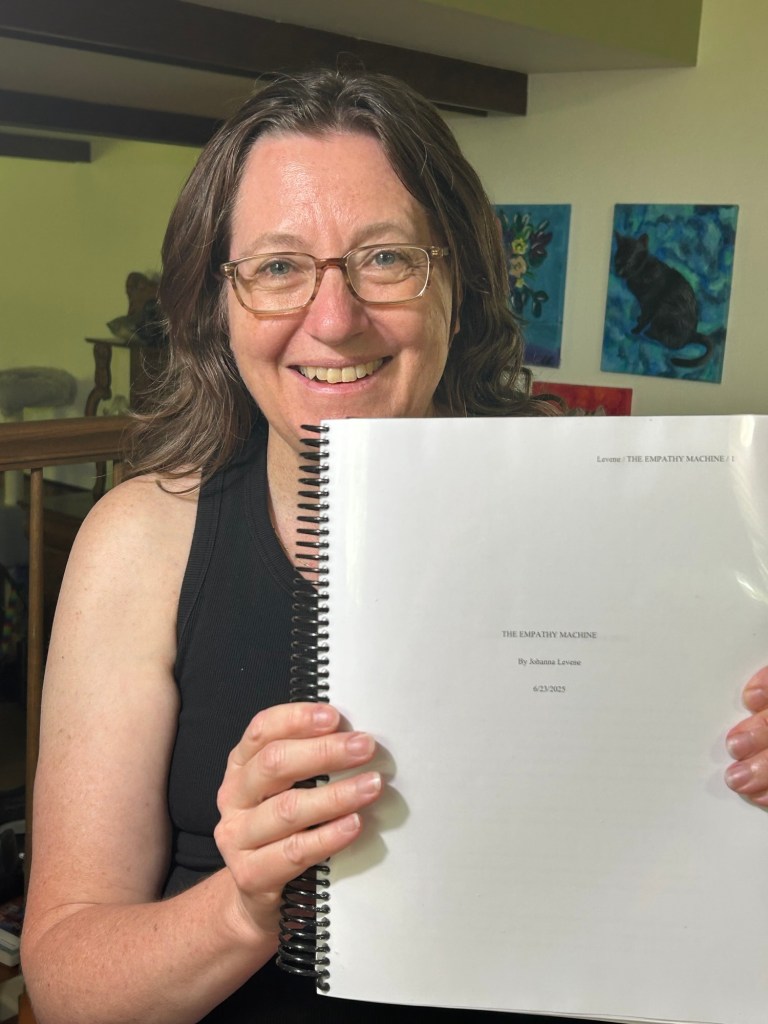
On Friday June 13th I wrote “The End.” (Which is a totally fine date to finish your novel. No bad omens associated with Friday the thirteenth at all.) Then I read and edited and spell checked and edited some more until June 23rd when I printed out all 285 pages and presented it to mom. Part one of my goal accomplished.

(Mom took this picture of me and my book. We are at her kitchen table. I normally hate how I look in pictures, but not this time. Look at how happy I am.)

I’ve read many writing books. I think Stephen King is the one who said that writing is magic. In my head was a world, characters and actions. Part one of the magic is the transference from my head onto the paper. To the best of my abilities, I accomplished that. I’ve read my complete book twice since writing “The End” and I believe the story is there. Could it be better? Yeah. (The comma situation is certainly dicey.) Could the story be better? Maybe, but not from what my own eyes can see or my own brain can comprehend. Now I need to find out if I accomplished the second part of the magic: can someone else’s eyes and brain read the story and interpret it? I don’t know, but I’m about to find out. Feedback from my mom, my writing group, and my husband is coming. I’m trying to be brave.

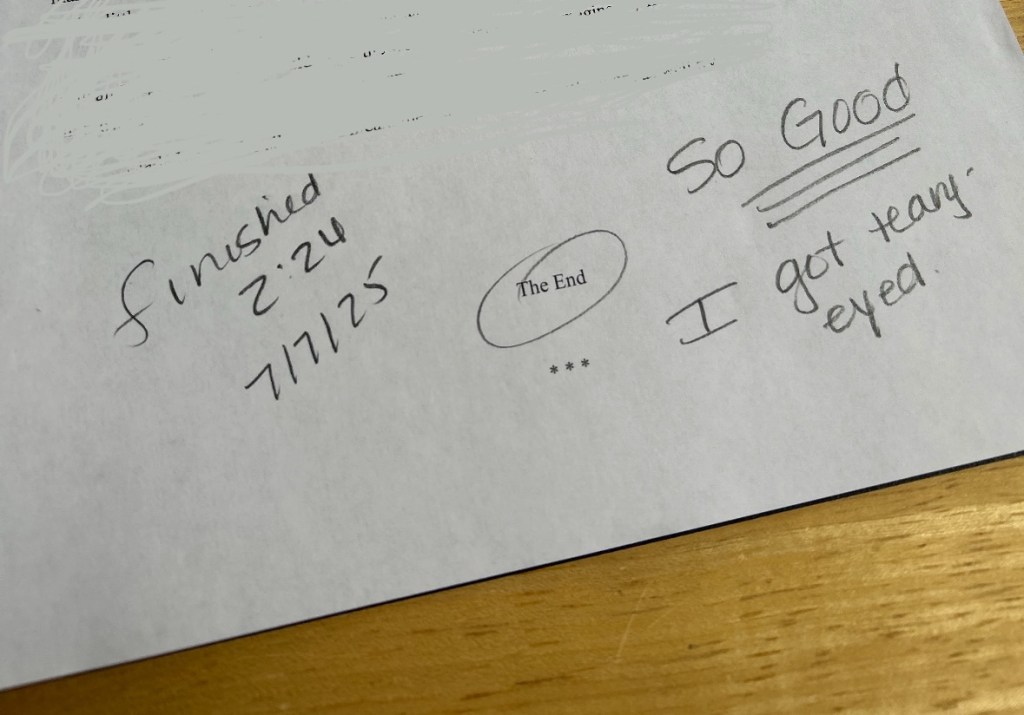
I have little glimmers that give me hope. As they have finished, my writing group has sent texts saying “It’s wonderful” and “It’s a big wonderful book.” (At 107,000 words, it’s a bit of a behemoth.) Mom finished on July 7th and sent me a picture of the last page of my book. On it she wrote, “So good” underlined three times and “I got teary eyed.” I got teary eyed when she sent me the picture.

Mom’s “The End”

I’ve had a month to celebrate. A month to marvel at my accomplishment. I left 20 years of stability, a nice paycheck, and great benefits for a dream. That dream is now a physical hunk of word-filled paper big enough to cause death to a bug or pain to a foot if dropped.

No matter what the next few weeks of critique and discussion brings, I want to acknowledge that I achieved my dream and that’s pretty gosh darn amazing. (I can say that here, because everyone stopped reading after the first braggy paragraph, right?)

The End

Reflections: 6 months into my writing sabbatical

It’s been 6 months and 6 days since I stepped away from my job supporting the US Department of Energy, US Federal Highway Administration, US Joint Office of Energy and Transportation, and National Resources Canada where I helped build and document electric charging stations and alternative fuel stations around northern North America. When I left, the election hadn’t happened yet. Kamala Harris was 47 days into her campaign and people at work were confident in her presidency. I even had one of my bosses scoff at me when I mentioned that one of my reasons for leaving was the potential impact on our work from a Trump presidency. He insisted, “That’s never going to happen.”

It happened. One day shy of two months after I left my job supporting the Federal Government Trump won. Four and a half months after I left he took office, and since then I’ve watched from a distance as he’s demolished the work I spent decades building. It’s weird not being in the trenches with my old co-workers trying to salvage what we can.

I swear, if one more person asks me, “Aren’t you SOOOO GLAD you got out when you did?” I’m going to punch them. I’m sorry if it’s you, but I’m sick of it. I worked in public service because I believe in the importance of what the government does for it’s people. I built a team of smart, innovative, caring people who wanted to change the world and our country for the better. I left for a year, not because I wanted to be the first in the swamp drainage, but because I was tired and burned out from working and doing so much. My job consisted of managing 25 people with 30% of my time, and with the other 70% I supported a $16M portfolio, did business development, and managed five of my own projects where I was an individual contributor. I’m so fucking tired of hearing the bullshit about lazy government workers who do nothing. That was not my experience. I’m sick that my team and my projects are being demolished and I can’t help. But I also know that if I was still there, I’d probably be locked away in some padded room rocking slowly, because I was so far over capacity. I would have had no ability to continue working my ass off while the president and his cabinet destroyed our government.

Instead of having an insider’s perspective on the dismantling of the great experiment that was the United States of America’s constitutional division of power, I have been writing. I also left my job, because I had a dream I wanted to realize: to finish my novel. My first month I polished up a short fiction piece, that I love, called Bumblecat. I’m afraid it might never find a home because it’s been rejected five times since I started shopping it around, and it talks about the USDA, which may be dissolved any day. I wrote a second piece about becoming the United States Egg Czar. That one is quite funny, and was also rejected. (But the rejection said it was funny, so I know it is actually funny.) It’s going up on the blog this weekend, because it’s a timely piece and I don’t want it to expire. I hope you like it. The third piece, which will go up on my blog next week is a gut wrencher of a piece about my cat who died in November of 2024. It was also rejected and since it is outside of my normal satire and speculative fiction space and I’m not in the mood to research a bunch of new markets to reject me.

Rejection is my life’s theme right now. My daughter just got cut from the club basketball team she’s been playing on for 4 years, for her senior season. I’ve had 7 writing rejections in 2025. As a country, we are rejecting the values that I hold dear. Honestly, I feel like I exist in a universe that has no room for me.

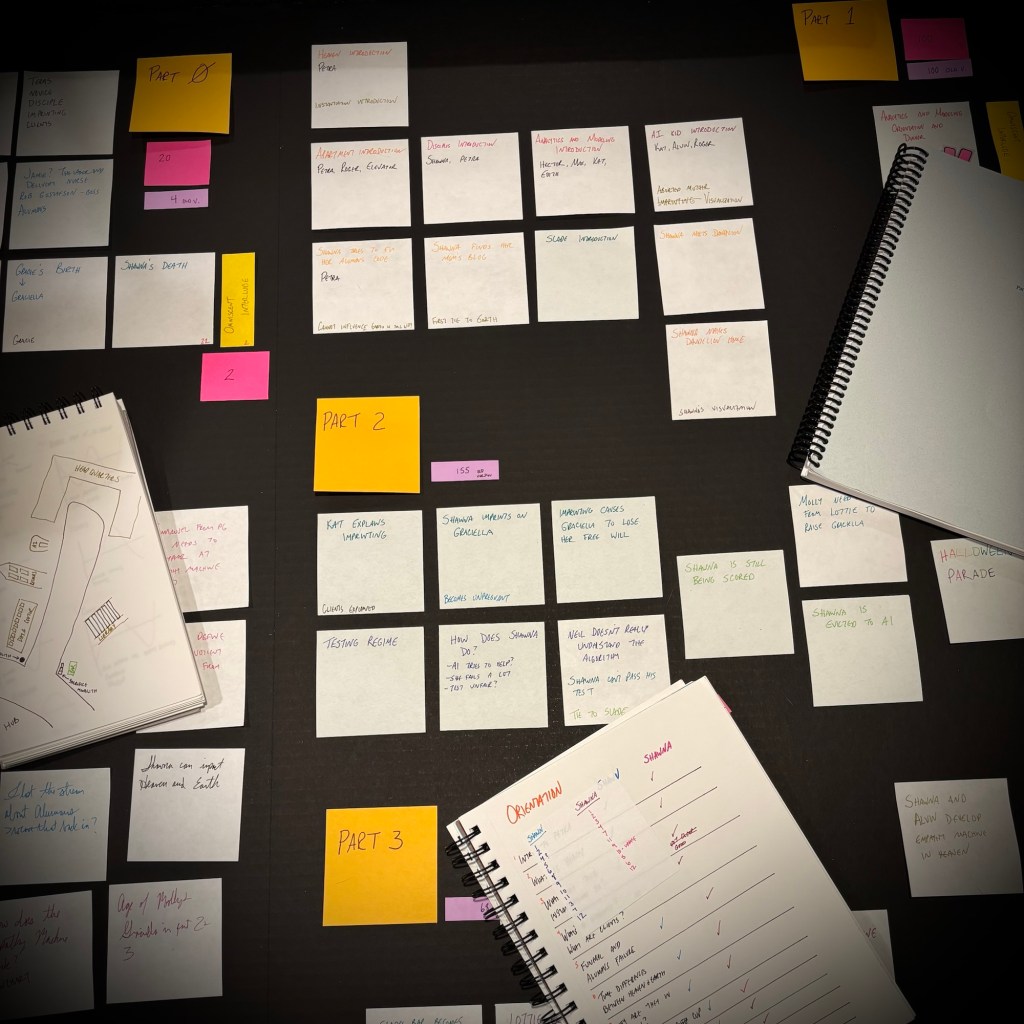
Thank goodness I’m creating a whole new universe where I can escape. While I’m woefully behind where I’d like to be in my book, I really like it. The people are fascinating and their struggles are meaningful. When I left in September, I expected to have the manuscript done and ready to start shipping to agents by the end of this month. Ha ha. Turns out creative pursuits do not work like technical projects. I can’t lay out a Gantt chart filled with deliverables, milestones, and deadlines and make something like a novel happen. Thankfully after about 3 months of forcing myself to a schedule, I modified my approach and now have half of a book done. I’ve got a plan for the final half all written out with colorful pens on sticky notes stuck to a cardboard thing you’d use at a science fair. I know where I’m going and I’m excited about the direction. I’ve also got book 2 pretty solidified in my head, and book 3 keeps popping in to say “hello.”

The plan was to give this writing thing a year, and then go back to work. But right now, I don’t think there will be work to go back to. My expertise in electric cars and electric car charging has limited value in our country. My 20 years of experience working across the Federal Government is meaningless once the departments I know are dissolved. And everything I write gets rejected, so even if I get this book done, it’s unlikely to ever find a home. All I can do on a daily basis is kick all those worries down the road for future Johanna. Present Johanna still has 6 months of freedom to finish her dream of writing a book, and I try to push away the fear and worry to focus on creating a new world that doesn’t suck as much as this one. Hopefully you’ll get to read about it someday.

An Extremely Belated Celebration

2020 was a crazy year. In the midst of a global pandemic, I had a really good thing happen. But I never shared the really good thing on Afthead, because Afthead was a public place and the really good thing wasn’t necessarily something I wanted people to know about. Okay, I didn’t want my friends to know, because I was extremely frustrated with some of their COVID protocols, or lack thereof. To cope I wrote a satire piece about them and it got published in McSweeney’s Internet Tendency. This publication is a big deal in the humor world. McSweeney’s acceptance rate hovers right around 1%. It’s like getting into the Stanford-Harvard of magazines. I highly recommend checking it out.

Somehow, the idea of reaching out to all my friends whose food intolerances I’d fastidiously honored in the past and telling them that I was publicly mocking them seemed wrong. Also, I wasn’t in a good place with many of them when it was published. I was busy being lonely and angry while they were out camping without me, because I wanted to do ridiculous things like wear a mask. Or their kids were doing remote school together because it was so hard on them.

Four years in the future, several of those people are my friends again (and the ones who aren’t never really were). Most of us have talked about how we were all doing the best we could during those really hard times, and have forgiven each other. Or we just let it go.

But I still haven’t mentioned to them about the most popular thing I’ve ever written. I didn’t tell them that afterwards I got interviewed by The Writer magazine, featured in an article about getting COVID-19 stories published. I didn’t share all the emails I got from strangers telling me how they were struggling too. I didn’t forward the funny comment from Facebook, “Licorice has gluten?” I didn’t want to stretch those strained relationships any farther.

So why post this now? Why not just let the happiness stay quarantined? A couple of things have changed. First, I realized that the friends I was frustrated with don’t read this blog. They don’t see my words. Unless I print this out and shove it under their windshield wipers they won’t know. Also, I did tell lots of people. Work friends got a link. Family got a link. People who I know didn’t follow my exact protocols read it and enjoyed it. Finally, I’ve told everyone I’m taking a year off to write. If I’m a writer, I want to celebrate my writing successes. I decided four years was enough space. It’s okay to let out a little celebratory yay about this piece and say I’m proud of it.

The magical thing about this piece was that it all came out in a whoosh. Normally my writing has tens of drafts littering a piece-specific folder on my computer. (Even this post has 22 revisions!) For my McSweeney’s piece there’s not a single draft on my computer. I wrote it, edited it, and published it from one file. I remember showering and furiously crafting this letter I would send to my friends. I didn’t write a word until I had all the biting phrases worked out. It was like I’d birthed the story fully formed out of my fingertips. Such magic should be acknowledged.

The last amazing thing about this piece? I was in the middle of graduate school when I wrote it. I hadn’t had a creative urge since March 13, 2020 when we all got sent home from work and school to survive the end of the world. I was taking my last two master’s level classes before my capstone. I was working full time and helping my kid do school from home. I was terrified for my parent’s lives, and my support system was fractured and frayed because of my community’s disagreement on the pandemic. It was a horrible, horrible time, and I dealt with it by producing witty, poignant, biting satire. Looking back, I am in awe of myself.

If you want to take a trip back in time and see how September of 2020 felt, now’s your chance. It was a time before COVID vaccinations. We were on the cusp of a huge winter surge. 700 people were dying a day. Somehow I coped by crafting words like this:

People can have COVID and not know it, kind of like that irresponsible room mom last Halloween that didn’t know licorice has gluten. Mistakes happen. You might be laughing and shouting germs all over and never know until someone gets sick. Imagine how embarrassed you’d feel if you accidentally killed my parents. They say hi by the way.

The little masterpiece is still online at McSweeney’s if you feel like taking a trip down that horrific memory lane. Me? I’m going to go reread the acceptance note. It’s glorious.

Thanks for the submission. This is great. We will take it! It should run in the next few weeks. Would you mind sending me a photo and bio for your author profile? 

Would I mind? Uh, heck no! Yeah, I have an author profile on McSweeney’s too. Pretty cool, even four years later.

So, Watcha been Doin’?

My desk at Library #4

It’s been two weeks since I left my job to live the dream of being a full time writer. Inevitably, everyone’s first questions are “Are you writing?” or “How’s your book coming?” My first week I had a list of activities that would prove to myself and my friends that I was doing the writing thing. I investigated libraries as writing offices. I became my own tech support and installed a new battery in my laptop, then downloaded Scrivner (a software package for writers). I took the Scrivner tutorial, then found all my novel files, and uploaded them into the Scrivner novel template. I rearranged my desk into a writer’s desk, rather than a worker’s desk. I wrote a blog post. I made a writing plan. I worked on a short story. I created a to-do list for my novel rewrite. I started reading a writing book. Look at me becoming a full-time-writer.

But I also left my job for personal reasons. My connections to people outside of work were degrading. So I made cookies for a friend who had a death in the family. I attended parent teacher conferences. I went to therapy. I sent a short story to my mom, so she could help make it better. I went on an anniversary hike with my husband and cut his hair. I fixed our YMCA membership so I could start taking classes and work on my physical health. I managed to slowly run a 5k. I drove my kid to volunteer activities and concerts and helped rescue her broken car. Look at me fixing myself and my friends and family.

The first week was just like working, but at a different job, which is what I told everyone I was going to do. I was proud of my accomplishments, and friends were impressed with how I’d transitioned right over to this new life.

The second week tells a different story.

I also left my job because I was exhausted and my personal life and home life were suffering. All that came crashing in the second week. The cat boxes and guinea pig cages were filthy. I still had seven performance reviews to write for the job I quit. (Yeah, I know, unpaid labor, but it was for people I care about.) My health insurance expires soon, so I got my COVID and flu shots, then spent a day and a half asleep in bed. (My normal booster after-effects, but since my only COVID infection lasted 10 days, I keep getting boosted.) I had my final OB/GYN appointment complete with pap smear. Midweek, I tried a full self-care yoga-mom day: I bought tickets for our winter trip; I actually went to a yoga class; I got my nails done with my daughter (homecoming for her, simple vanity for me). I tried to include more people in my week. I had lunch and walked with friends and spent an hour picking apples with my mom in her backyard. The weekend was filled with homecoming activities – volunteering, unexpectedly staying for the football game to visit with friends, steaming my kid’s dress, taking homecoming pictures, and delivering forgotten items around town. The only writer thing I accomplished was working on my short story, visiting a third library, and thinking a lot about my book. One might say I failed week 2 as a writer.

Three weeks ago my days were dictated by my Outlook calendar. Life was scheduled from 8-4 (or 7-6 on a bad day) in half hour or hour chunks going from meeting to meeting to meeting. Often I didn’t have time for lunch, and bathroom breaks were quick jaunts where I had to wait to start my next conference call because you could hear the toilet flushing from my desk. Milestones were set and documented with clients. I had no time to think deeply or be thoughtful.

My other issue is that I’ve been working since I was 14, and working full time since I was 23. Gosh. I’ve been working full time more than half my life. The only break I’ve had in those 27 years was 13 weeks for maternity leave. Okay, I also went down to 32 hours for about a year when my kiddo had non-stop ear infections, and then went down to 32 hours during my last year of my master’s degree, but in both of those cases the extra hours I wasn’t workin’ for the man were dictated by someone other than me. It wasn’t like this. I really don’t know how to not work a regular job.

This is a whole different life in an unexpected way. I’m responsible for deciding what I’m going to do. I’ll write my own performance review. I get to report if I’m succeeding or failing. Am I allowed to take a day off? Can I knit during working hours? Can I write after hours? What are my hours? Is napping allowed? Someone forgot to give me the unemployed workers handbook. This week, I’m going to choose to be kind to myself. Anyone who has worked for me will say that I tell everyone to expect a struggle in the first 3 months of a new job. I’m going to give myself a little of my own managerial grace as I figure this out.

I’m writing this post from library number four. (Oddly, a library I started working at when I was 16.) So far, I’ve found 3 of the 4 libraries to be productive writing work spaces. They have the right amount of background noise and I like being surrounded by books. Today I was able to research points of view from books in the 808 nonfiction section. (I love the Dewey Decimal System.) I’ve got a plan for figuring out if my novel needs first person, third person omniscient, or an editorial narrator. I’m excited about doing some writing on my actual book, not because it’s on a to do list, but because I’m curious. Tonight is writer’s group and I have a writing conference this weekend. I have absolutely promised myself that I won’t let the writing conference crush my soul, as they often do. If I start to hate a session I can leave. I don’t have to go the whole time.

I’m glad that I’m keeping track of my days, because I want to know what makes a day good and productive and what days are frustrating. Just like in my other job, I’ve found that the to-do items I don’t finish make me angry at myself, but I still forget all the things I did accomplish. Going back to review makes me feel better. I haven’t “wasted two weeks” because I haven’t rewritten 87 pages of my novel. I’m being thoughtful with my time and activities. Instead of thinking that I’ve squandered 1/26th of my year off, I’m going to focus on how I’ve set myself up to make the next 25/26ths a success, however I end up defining success.

Happy Birthday to Me

For my 50th birthday I am giving myself a gift. The biggest gift (monetarily) I will ever give or receive. (Well unless I get all philosophical and consider the gift of life to my kid, but that’s outside the scope of this post.) I am quitting my job to take a year off to write my book. Goodbye annual salary, hello priceless time.

I started this book in 2013, eleven years ago. Since then I’ve raised my kid to driving age, started and finished a master’s degree, got promoted, grew my team to twenty-three people, visited the White House and increased our team’s portfolio to $10M dollars. But do you know what I haven’t done? I haven’t written my book. I published an essay, a satire piece, and a short story, and was racing into 2020 on a high of acceptances. But then my writing started suffering. It suffered because, for me, a global pandemic and a creative mindset did not go hand in hand. It also suffered because of my master’s capstone completion in November of 2020 and my subsequent brain-fry hangover. It suffered because I took an “opportunity” to do a second role at the same place I already had a job. But about a year ago, I was down to one job, my degree was a memory in a frame, I survived COVID, and the creativity dam broke and I really, really, really wanted to start writing again.

Only an idiot would quit their lucrative high-paying career as a 50-year-old woman. I don’t have a single friend who can’t tell a horror story about a middle-aged woman getting forced out for being too old. I myself was recently informed, by a younger male colleague, that I wasn’t “hungry enough” to do my job effectively. If I quit now, I might never work again. This is conventional wisdom and even my six page list of contacts isn’t enough to make me consider that I’m not murdering my future job prospects with this move.

In 2016 I had a plan. I would get my Master’s degree, as required for female upward mobility at my company, then I would work for a year as required for tuition reimbursement by my company, and then I would apply for a year long sabbatical to finish my book. I would get a break, accomplish my dreams, and go back to work. It was a perfect plan destroyed by COVID-19 and bureaucracy. By the time I wanted to write again the leave policy had changed and the sabbatical requirement had changed to require relevancy to the mission of my workplace. My novel is not relevant.

Why not wait until retirement? What’s another 15 years of work? Can’t your dreams wait? Couldn’t you just find time to write? Your kid’s going to college soon, you’ll have plenty of time to write then. Just give it a couple more years. The fiscally conservative engineering voices in my head have plenty of reasons for me not do this. My heart has a different perspective.

As a fan of Stephen King’s On Writing, I am a believer in the ideal reader. Each writer has a person they are writing for, and my book is being written for my mom. In the past few years, I have made a remarkable discovery. My parents are not getting younger, and a couple of health scares with my dad has been a terrifying reminder that they are not immortal. So if I want my ideal reader to read my book, I best write it while she’s still alive, don’t you think?

I also have an obligation to my daughter. She’s getting ready to go off into the world as a new adult, and has said things to me and my husband like, “I don’t want to hate my job like you two do.” Now she’s a pessimist, but I do complain a lot about my job, and while I want her to learn responsibility and stick-to-itiveness, I feel like I’ve gone above and beyond in modeling that behavior. I also want her to see that you only have one life and dreams are not worthless. She was the one, when I told her my plan, said, “Well mom, when you sell your book, you’ll make up that lost salary, right?” She voiced the dream I am afraid to even ponder, because that engineer brain in my head knows all the statistics about the impossibility of publication. While she is living with me, I want her to see the joy, the pain, the price, and (hopefully) the payback of dreams.

Tomorrow this little egg of a dream will be hatched. I will tell my boss. The next day I will tell my team. I will begin the process of transition. I have a list of tasks and the people I think can take them over. Tomorrow people other than my trusted family and friends will know. People will be hurt. People will be angry. People won’t understand. People will mock and eye roll and smirk. People will be glad. People will see opportunity. People might be inspired. Tomorrow this won’t just be about me, but will be about everyone else. I’m writing this today so that I can remember why I’m doing this before everyone else has an opinion. Why it’s important to me. Why I want and deserve this gift.

The Great Life Contraction

My daughter learning to drive

I sense a change coming.  At almost fifty years, for the first time, my life is about to get smaller.  I’m not sure how I feel about it.  Part of me is exhausted managing 17 people at work, boostering sports at the high school, parenting one child, managing one household, meeting with my writing group, trying to keep my body from falling apart, keeping a semblance of friendships, and contributing to two extended families.  My life is always full.  

The opportunities to do more are endless.  I could be a DECA judge at the high school or volunteer for the PTA; apply to an executive MBA or CTO program; run the women’s network at work.  They need me, while my heart longs to see my parents more or have a leisurely meal with friends. 

And there are so many people.  Work people, school people, sports people, family people, friend people, writing people, and neighbor people.  People I want to see and people who want to see me.  People I am obligated to see and people who think I’m obligated to see them.  Annual people like doctors and dentists.  Periodic people like sports, writing, and camping friends.  I could have coffee and lunch every day and still feel like I’m missing out on relationship connections.  With every new hire, new project, new school, new activity, or new interest my rolodex grows.  (A dated metaphor, but some of you know what I’m talking about.)

The first end is less then three months away.  My role as driver has a deadline.  There is no indication that my daughter will do anything but pass her test, get her license, and never need me to take her anywhere ever again.  Okay, I’m exaggerating, but this feels like the first official life contraction.  Sure other parenting tasks end, but for the most part they are replaced.  I don’t have to change diapers or mash up food anymore, but now I learn the nuances of lip gloss versus lip balm and make pancakes for sleepovers.  But driving is a task that grows as kids get older.  They have more activities that are farther away and take longer.  More friends and more opportunities to leave the house.  It’s not all a burden, because the parental time in the car is special.  The car is a safe zone where you find out secrets, hopes, and dreams.  I won’t have that view into my kid’s life anymore.

Driving also makes my life bigger.  I made friends with parents hanging out on the sidelines when my daughter was little.  I found new trails to walk as her sports took her all over the state.  Now, I wave to my kid’s friends when I do the permit driver switch at school.  I’m a basketball booster parent because the coach saw me after practice, and we got to talk for a minute.  Suddenly those relationships, experiences and interactions will be gone – abdicated to my kiddo to maintain.  

I love being a parent, and recognize this is the beginning of the great metamorphosis from hands on to hands off.  From loving a child to loving an adult.  Not far out are pre-college camps, which she’ll do solo.  My best travel buddy’s first travels alone.  Then college.  That’s the big one.  In two and a half years I’ll go from living as a household of three to a household of two.  No games to attend.  No parent teacher conferences.  No back to school nights.  Suddenly priorities in my life will go back to being determined by me – not a school schedule or a sports schedule.  

What will I do with myself?  I used to do this cool thing called working out, and it made my body and mind feel amazing.  But I usually did that with friends, and how do I find friends who run if I’m not going to soccer practice and running stupid one-mile loops on the concrete path around the soccer fields?  I like watching sporting events, but how does that feel when you aren’t surrounded by the parents and friends of the kids playing?  What will provide the rhythm to my days and years?  Where will I meet new people?  And do I really have to just hang out with my husband every day, all day?  

Honestly, I’m ready for a little space.  Time to return to things I love.  My writing has suffered.  I miss my close relationships.  I long for interactions that don’t have to fit into a smidge of time scraped out between activities.  Maybe I’ll actually be able to respond to work emails again?  (Probably not.)  Maybe I’ll be able to nurture friendships who have gone stale, or build stronger friendships with people whose lives don’t quite match my rhythms now?  I long for complex foods with spices and heat that fill the house with smells my daughter despises.

Where does it end?  Friends are retiring and I see how hard it is to maintain relationships between working and retired people.  Your lives become different, so I’ll keep losing friends as they leave the workforce, but will we reconnect when I retire?  My parent’s friends keep dying and their world gets smaller with every loss.  Is this part of the natural cycle of life?  Your world expands to a peak of fullness beyond comfort and joy beyond maintainability and then contracts back down to a tiny family unit then a lonely end?  What happens on the other side of parenting, of work, of health?

I’m hoping there is a time of contentment between now and death.  A time to be thoughtful.  A time to breathe and focus on the things and people I love, including myself.  A time when I do what I do because it’s important and not urgent.  A chance to want to do things and no longer have to do things.  I hold this hope close to offset the fear as the losses loom.  I am ready for some time alone, but I am not ready to be lonely.    

Twas the night before publication…

Twas the night before publication, and all through the house not a creature was stirring except me because gosh darn it, holy moly, gee whiz my first short story is getting published tomorrow!  Monday, June 3rd is publication day.  After a rough few years of submitting and being rejected, then completely quitting for a bit, I’ve had a run of acceptances.  (Is two a run?  I feel like it is.)  My first creative essay was published online April 20th and now my first fiction story will come out tomorrow.  Tomorrow, tomorrow, I love ya, tomorrow….

Grork Dentist will be published by Luna Station Quarterly, a magazine in their tenth year of publication.  I’ve loved Luna Station Quarterly since I first came across Holly Lyn Walrath’s story The Joy of Baking.  It’s a magazine with a cool mission: publishing speculative fiction by women-identified writers.  I love that they do a print and online publication (I’ve got four print copies arriving Tuesday from Amazon, thank you very much.)  It’s easy to share online publications with friends and family, but likewise really special to have a print copy of your very own story to hold, and smell, and sleep with, and carry in your purse everywhere, and give to your mom, and accidentally leave at your dentist office and… and…. I might need to order more copies.

The other cool thing?  I got to write my very own real live author bio.  I mean, does it get any more official than that?  My full bio is online and a shortened version will appear with my story.  Nothing makes you feel more like a real honest to goodness writer than a bio.  That is, not until tomorrow when I see my story.  I bet that will feel even better.

It’s funny, because I spend a lot of time with the Twitter writing community.  (Too much time, but hey, it got me my first publication.)  I’ve read how getting your story published doesn’t change anything.  My expectations will just get adjusted and I’ll want bigger and better things.  I must disagree.  For me, getting my first story published means the world.  As great as this story’s rejections were from high quality magazines — “We loved this story’s delightfully ridiculous concept” and “there’s some good writing here” — nothing equaled the joy of “We would like to publish your story, “Grork Dentist”, in the next issue of Luna Station Quarterly. Thank you for submitting!”  Getting a story you are proud of accepted into a journal you love is a very special feeling.  I’m now no longer afraid of calling myself a writer, and the publication has made me believe that my stories are worth writing and worth being read.  That feeds my writing soul.

Tomorrow I’m going to be refreshing my browser like an idiot waiting for the cover image to change and my story to show up.  Until then, I’ll be like a kid waiting for Santa, the Tooth Fairy, and the Easter Bunny to all show up overnight and bring me the best present imaginable.  Happy publication eve to all, and to all a good night.

Polymath Puberty Ponder

seb-creativo-197860-unsplash

There are times when all my roles in life — mother, graduate student, writer, and professional — threaten to draw and quarter me.  I’m pulled in different directions and the pain of not doing my best at anything rips me apart.  Then there are other times that epiphanies happen, and could only happen, because I see the world from so many angles.

It started with the note home from school.  The anticipated but dreaded permission form for my daughter’s puberty class.  The coming-of-age embarrassment of all children when they start to stink, have to think about a bra, or experience “nocturnal emissions”.  Nocturnal emissions?  When did wet dreams get such a fancy name?  I reread the note to make sure it meant a boy waking up in sticky sheets.  Yep.  The note clearly said “nocturnal emissions.”  Apparently it’s not just new math these kids are learning, but new puberty too.

That same week, I had to submit my graduate school capstone project proposal.  I’m leveraging a work project on alternative fuel corridors to examine how the climate impacts of the World Cup and Olympics could be mitigated by utilizing alternative fuel.  It’s a great proposal that hits the sweet spot of a school project for me: something that extends a work project and gets me credit from both school and clients.  As I was researching my proposal I found some fascinating journal articles that discussed the importance of delivery timing during mega-events.  The goal is to ensure that souvenir and food deliveries don’t impact spectators getting to events, and one of the strategies is to make deliveries at night.

Without warning, my writer brain engaged.  I had the perfect proposal topic.  If I shifted my focus to the Women’s World Cup happening in France this summer and refocused on the temporal aspects of the study I could title my capstone: Calculating Nocturnal Emissions resulting from the 2019 Women’s World Cup.

Now who wouldn’t want to read that?


Photo by Seb Creativo on Unsplash

Acceptance

LeveneJohanna_0162

I’ve been sending little stories of mine off to journals to be read, judged, and rejected.  From 2015 to 2017 I had one story rejected four times.  Then last year I got brave.  I threw three stories to the winds and let the rejections flow: ten of them.  I worked hard to perfect those little tales.  My writing group read them and gave feedback.  My mom read them and gave feedback.  My husband read them, corrected my grammar, and disliked them.  I even donated enough money to a new journal so a real live editor could critique my story.  I worked and tweaked, and while the rejections kept coming they started to give me hope.

My favorite rejection?  One that ended, “We loved this story’s delightfully ridiculous concept, but we felt the story didn’t have enough conflict to support it through the middle and ending.”  Um, the words love and this story appear together in this delightful rejection.  It almost feels like an acceptance….almost.  Another was rejected the day before they sent out the list of anthology finalists.  They said, “…there’s some nice writing in the story, but unfortunately we felt it just wasn’t quite right for the collection.”  Nice writing?  That’s enough to make me brave enough to submit somewhere else, and to watch this journal’s calendar carefully so I can submit to them again.

I know that ten rejections in a year is nothing.  One of my favorite blogs, Rejectomancy,  has a whole formula for calculating your power as a rejectomancer.  Aeryn, the blog’s author, revels in his rejections, having just tallied his 300th rejection.  Three hundred.  I love Aeryn’s blog because it’s really hard for me to get all freaked out about 10 rejections when he’s statistically analyzing three hundred.  Also, I’m not just a writer but also a geeky spreadsheet loving engineer, so recording and analyzing rejections is a form of comfort for me.  Another comfort?  Watching your Rejectomancy score increase as you get different types of rejections.  By the end of 2018 I was at 20 points: a glass level rejectomancer aiming for ceramic.  (Really, this system is so amazingly nerdy!)

2019 hit and I was ready to submit like mad.  Armed with my positive feedback and desire to rise through the Rejectomancy ranks, on a whim, I submit to a journal I had not researched that promised personalized feedback.  The story I sent had already received one lovely personalized rejection – the nice writing one – and one form rejection.  It was a piece I loved and felt confident about.  The day after submission I was rejected with a full page of detailed information about how horrible my story was, what a terrible writer I am, how the concept was interesting but horribly executed, and the ending sucked.  It would have been kinder and more succinct to reply, “You are a terrible writer with no concept of story.  Your words caused my eyes to bleed.  Cut your hands off so your tales never torture again.”

So I quit writing.  I quit submitting.  I quit my writers group.  I quit.  The end.  Eleven rejections was all I’d ever see.  It was one thing to get rejected with kind words and another to have strangers rip me to shreds.  Writing wasn’t worth it.

Except, I didn’t really.  In Bird by Bird, Anne Lamont talks about writing presents, “Twice now I have written books that began as presents to people I loved who were going to die.”  The concept of writing presents speaks to me, drives my desire to finish my novels, and made me write a love letter to myself.  I wasn’t dying, but my hope and dreams of being published were dying, so when I saw a tweet for the 1000 Love, You Letter’s project I started to write.

The concept is not really me.  I am not a self-love essay writing kind of gal.  I’m an alien dentist, fisherman of children’s souls, bumblecat type of writer.  I’ve got stories about convicts puking, the end of the world, and heaven being destroyed by bureaucracy, but my dying craft cried for a story, a goodbye, a last hurrah, so I wrote myself a love letter.  No one read it but me.  No one edited it.  No one even knew it existed.  I wasn’t going to send it, but my tribute required a submission, so I sent off my letter.

The submission’s initial response is what you would expect from a project collecting letters from women writing love letters to themselves.  “This is a beautiful letter and we’re thankful for you trusting us to share it with the world.”  Sweet, and what you’d want every vulnerable woman essayist to hear.  Writing a love letter to yourself is an embarrassing emotional effort, and even more embarrassing knowing that others are going to read what you wrote.  Urban Ivy, the publisher, does a wonderful job of making the brave women who submit to them feel valued and that kindness was a salve to my broken writer’s heart.

Before I quit writing, I dreamed of seeing my story in print on a piece of paper.  Not on a website, but on a tangible page where I could run my finger over the text.  Something that I could put on a bookshelf and read until it was tattered.  Something that, when I was old, would smell like old paper and ink.  My submissions were brave and bold, targeting the journals that still print and accept less than 0.5% of the stories they receive.  I had a plan to move onto online journals once I’d exhausted the list of print publications.

The submission response from the 1,000 Love, You Letter project also said, “We will be in touch by March 15 to share which letters will be published in the Love, You book and on our social media!”  Even though I had quit writing, this little glow of hope that I find hard to extinguish grew as I watched the social media announcements about the project.

On International Woman’s Day, Friday March 8th, a message in my inbox was titled, “Your Love, You letter has been selected!”  I was stuck in a traffic jam on the highway so checked my email. (Totally unsafe. Never do this.)  I didn’t want to read the email on the road, but my glow of hope spread during the 20 minutes it took me to get to work.  My dream of publication might be coming true.  I wondered if there was going to be a request to send my bank account information to a prince in Nigeria before they published.   Then I yelled at myself to just be happy for once and not think how this could go wrong.  I thought about who I wanted to tell and how.  Once I parked, I reopened my email and read, “We’re excited to share that your letter has been selected to be featured in the Love You Book which is set to publish this Fall and will also appear on the 1000 Love You Letter website within the next few weeks.”

I burst into tears.  Happy tears.  Accomplishment tears.  Dream tears.  Tears I never thought I’d be able to shed but always wanted to shed.  My present to myself was going to be published, and not just published, but published in a book.  I unquit writing right there and then.

A week later I’m stalking the publisher, Urban Ivy, the letters that are already being published online, and the Instagram and Twitter feeds about the project.  I’m liking and retweeting and anxiously awaiting the next steps.  10 points were added to my rejectomancer score jolting me right past the ceramic level and on my way to denim.  My confidence restored, I resubmit my one-day-rejection story to a journal I love in hopes that it will find a home there, or at least some kind words.  I returned to my writing group, tail between my legs, and told them of my acceptance and thanked them for their kind words that I had ignored while I was feeling sorry for myself.  Because they are awesome people, and writers too, they welcomed me back.  Slowly I’ve been telling family and friends, while savoring my happiness.

I wish this fairy tale ending on everyone.  I hope that every low point is offset with a high, but I know that this is a wonderful, beautiful anomaly.  Unquit writer me is going to  continue to have mean things said about her writing.  If I’m really successful, people will rant about me the way I rant about Neal Stephenson and Paolo Bacigalupi; I cannot stand the famous, successful, prizewinning works they produce.  I have to get thicker skin and grow from these experiences: both the bad one and the good one.

The primary wisdom I gained from this came from my good friend Lew Gibb, part of my amazing writing group, who said about my mean rejection, “My wife and I have a great saying that works in these types of situations: ‘If someone honks at you for more than a second, it’s not about you.’ Everyone’s dealing with their own shit. It’s obvious, since they did the literary equivalent of a three second honk, that your reviewer allowed their shit to overflow into your story.”  He’s right.  I need to be strong enough to tune out the long honks.  I need to value the cheers of myself and my friends more than nasty words generated in a single thoughtless day.  I can’t just write love letters when I’m down.  I want to remember that everything I write a present, even knowing that there will always be critics who despise my gift.

But guess what?  I’m going to be published!  Acceptance at last!  I cannot wait to hold this book.  I’ll need at least two copies: one to cherish and one to get spotty with I’m-holding-my-story tears.
Reading Debut Novels – 2017

As someone who would like to have a debut novel someday, I read the first book of several authors this year, and tried to read them as a writer.  What was it about these books that first grabbed an agent’s attention, then a publisher’s attention?  Was it possible I could do what they did someday?  My last reading post for the old year highlights debut novels.

Dissension, by Stacey Berg

Stacey is an author I’ve followed for some time on Twitter:  @slbscifi.  (She followed me back, so I’m not a total stalker.)  Berg is not only an author of speculative fiction YA books, but is also a medical researcher.  As a chemical engineer who dabbles in speculative fiction, I look to her as a role model for how one might balance a left brain career and a right brain writing avocation.

I love YA fiction, so enjoyed diving into Dissension.  It’s set in a post apocalyptic world where “the church” has taken over directing the survival of humanity.  The main character, Echo, is responsible for protecting the church and the populous.  Berg has created an engaging innovative world and Echo vacillates between being a heroine and an anti-heroine as the story unfolds.  The story was engaging, so I also read Berg’s second book, Regeneration.

From Berg I’ve learned that if you are a science person, you do not have to write fiction in your non-writer area of expertise.  Yes, there are medical aspects of Berg’s books that are important, but that is not what her story is about.  However, her books have a scientific quality that I enjoy:  they are organized and logical.  Understanding that my background can influence my writing but doesn’t need to limit my writing is a valuable lesson from Berg’s works.

I found Berg through Mary C. Moore, an agent I paid to review the first 10 pages of my novel, because I’m not just stalking authors through this little experiment of mine, I’m also looking for an agent who represents books similar to mine.

Mrs. Kimbel, by Jennifer Haigh

Ah, this Jennifer Haigh lady.  She taught me so much last year!  She taught me to find my keystone works for my own books – books that write the way I want my story told.  Then she taught me how she wrote her first book in a way she would never write a book again.  Mrs. Kimbel is a story is of three women, all married to the same man.  It was written as three discreet longish short stories that Haigh had to cram together into a novel: not a process she recommends.  It’s an interesting book, but outside of my normal preferred genre and style.  If you are a lover of interpersonal stories, I highly recommend it.  If you normally read crazy sci fi, epic fantasy, and apocalyptic fiction, maybe skip it.

Because Haigh was so negative about her process creating this first book, I wasn’t sure what I would learn from it.  But books never fail to inspire.  Haigh is a single woman with no kids and no career other than writing.  In her class I learned that she has eschewed a “traditional” life in favor of being a writer.  Writing is her priority.  So, I was surprised that her book about relationships and motherhood felt true.  Whenever an author believably writes about an experience they have not had I feel permission to write prose outside of my own life experiences.

Agent to the Stars, by John Scalzi

I adore John Scalzi.  I follow his blog.  I read his tweets.  I reply to his tweets.  (He replied back once, again proving to me that I’m not a total online stalker.)  I also love his books.  They feel like stories that actually happen.

Agent to the Stars, Scalzi’s first novel, is a funny little book about a Hollywood agent who represents an alien.  The book allows the reader to experience human first contact with a non-threatening new life-form.  True to Scalzi’s other works, it’s funny and unexpected.  The audiobook is a joy to listen to, read by Will Wheaton: one of my favorite readers.

From Scalzi’s first book, I learned about voice.  People have told me that my writing has “a good voice.”  I’ve read that agents are looking for works that are more than just technically accurate: they need a voice.  But voice is one of those nebulous things like love or faith or parenthood that you have to experience to understand.  Because I’ve read so much Scalzi has written I was able to sense his voice even in this first novel, and I think I understand the concept better now.  All Scalzi’s works are irreverent, unexpected, and highlight details other authors might gloss over.  Those details make his stories real, which I love.  From his first novel, Scalzi had voice, and maybe now I understand mine a bit better.

I learned so many different things from my first-book experiment, so am continuing it in 2018.  I just finished Point of Direction, a book by Rachel Weaver who is an instructor at Lighthouse Writers Workshop where I am a member.  I wanted to read Weaver’s book because she’s someone I can take writing classes from, and even ask annoying questions in person: an invaluable resource for the aspiring novelist.

My second planned first-book for 2018 is Markswoman by Rati Mehrotra.  (She’s a WordPress blogger too.)  I also found Mehrotra through Mary C. Moore, who recommended Mehrotra’s author website as one of her favorites.  Expecting some whiz-bang super-designed wonder, I was happy to see that Mehrotra’s site was well organized and easy to read, but not unobtainable.  I also found her site to be a wonderful resource for potential publication journals and she’s taught me what it looks like to be a more grown-up writer than myself.  Again, I follow Mehrotra on Twitter @Rati_Mehrotra – yes, she follows back – and have loved virtually celebrating the publication Markswoman.  (It just came out this past Tuesday, but it’s been so exciting to watch the pre-publication build up.)  I can’t wait to see what I’ll learn from this read.

That’s it.  All my reading analysis for 2017: the good, the bad, and the debut.  For 2018 I’m already 7 books in, and after Markswoman I’m going to dive into an Ursla K Le Guin story or two.  Shockingly, as a lover of speculative fiction, I’ve never read anything by her, and her death this week revealed what an inspiration she was to authors I love.  My bookstack is full, as always, with new stories to love and learn from.  Let me know if there’s anything you’ve read that I should add to the stack.