Editor’s Block

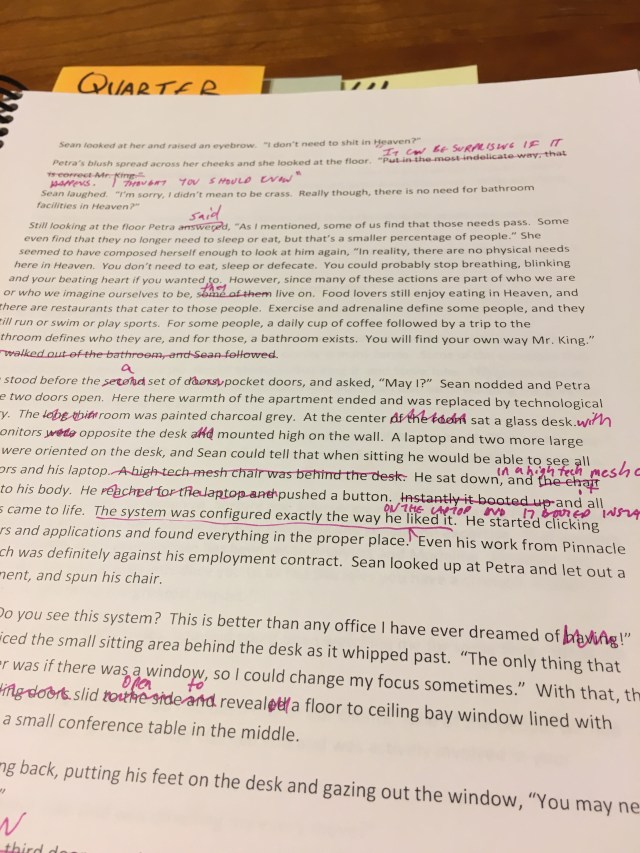
I got past my reader’s block in July and quickly moved into the next phase: editor’s block.  In this phase I stared at my 99,000 word manuscript and tried to figure out how to eat the editing elephant.  I would scribble word changes and deletions because I didn’t know what else to do.  I paid good money to learn how to write a query letter and sent my first 10 pages to an agent.  (This was through Writer’s Digest and I thought it provided great insight into the publishing process.  If you are almost done with editing and want to try conventional publishing this is a great resource.)  My assigned agent, Mary C. Moore, gave me some good tactical advice:  vary my sentence structure; keep prose active; don’t over explain smaller actions of characters; be aware of slow pace; and, most importantly, “Keep going with this, you are on the right track!”


img_0274

Armed with things to do, I made a goal to finish editing by Christmas.  I only needed to edit 3 pages a day.  Time passed and I didn’t edit so the goal became 5 pages per day.  Time passed and I realized I had no idea what I was doing.  It was like I had a plan to swim the
English Channel.  All I needed to do was swim an additional 100 meters every day but I didn’t know any strokes, didn’t have a swimsuit, and couldn’t identify water.  Despondent about my book progress and a host of other things I turned to my family therapist.  She told me to do two things: come out of my writing closet and find a writing group.  I’ve talked with other bloggers about writing groups, and while not enthused about the idea, I felt like I needed to find some experienced writing peeps to help me.  Minutes into my Google search I found Lighthouse Writers, a local “community for writers and readers.”  I joined, and then on a whim physically visited their space.  This wonderful woman stopped what she was doing, and joyfully took me on a tour of the amazing historic mansion that houses their program.  Lucky me, a four week session was just starting, and in it was a class called The Big Edit which promised to “turn the amorphous process of cleaning up your draft into a manageable practice.”  Gasp!  Of course it was full, so I got on the wait list.

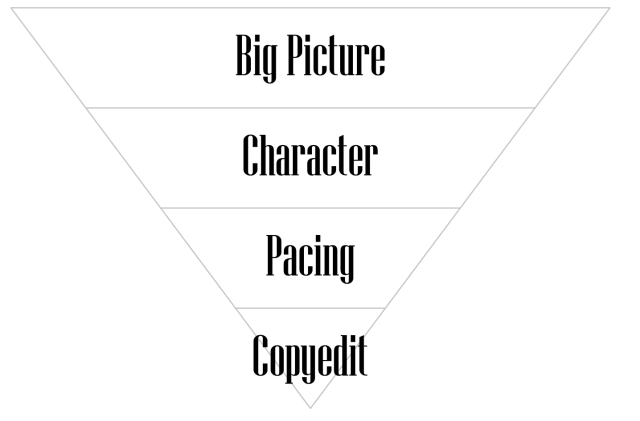
Providence does not put all these magical pieces in place just to snatch them away, so four days before the start of class a space opened. Eleanor Brown, the author of the New  York Times bestseller The Weird Sisters is the teacher and in the first fifteen minutes she laid out a process that made total sense.  She explained how we would edit in at least four passes.  We’d start with the Big Picture, move to Characters, then to Pacing and end with Copy and Line Editing.  (This means that I don’t have to worry about commas until the very last editing pass.  Hip hip hooray!)  This process isn’t quick, but I am okay with that.  I’ve spent years on this book.  I can invest another year so long as I’m moving forward.

bigedit

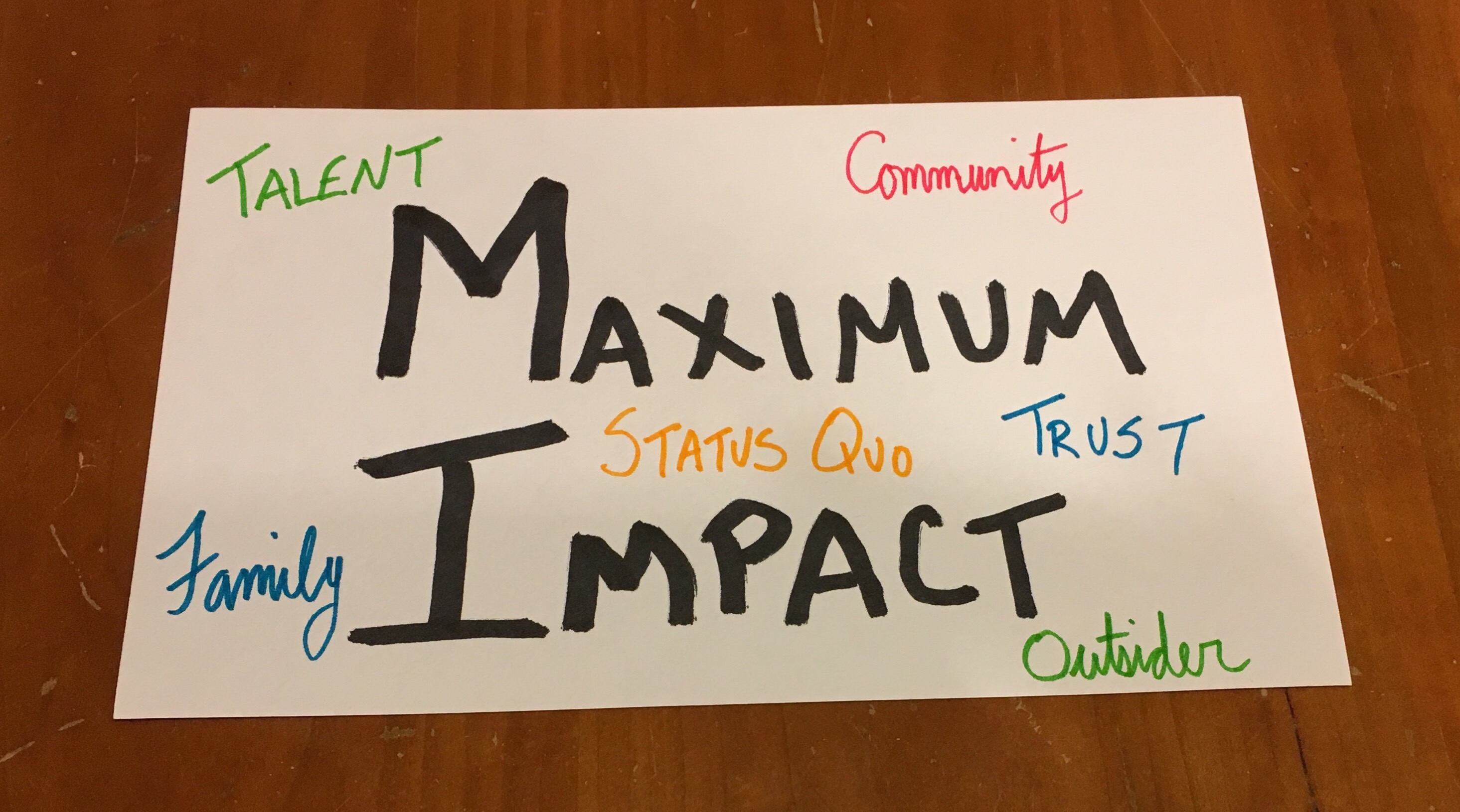
Not only has she given me a process to follow that makes total sense, but she’s also promised to help us discover our strengths and weaknesses as writers.  Through the class we’ll understand if we are good at theme, story, character, or pacing.   She’ll give us tips for adding editing passes for things like dialogue, humor, flashbacks or description that will help address weaknesses.  We will make a plan which allows us to stay focused and organized while developing a feeling of progress the same way we felt progress when writing.   We even have homework!  (I’m excited by this even though anyone who experienced my school days knows I hate homework!)  Here’s a picture of my first completed assignment: developing a theme card that I can hang above my writing space to remind me what my book is about.

In 2015 I came up with a list of nine things I needed to do to get my book published.  I’m still on step 2, having vastly underestimated the scope of the editing step.  But I have a plan now and cannot tell you how amazing that feels.  I have book hope for the first time in ages.  There is work to do, and I know what that work is.  I finally agree with Ms. Moore’s statement, “Keep going with this, you are on the right track!”  Time to get to it.  I’ve still got more homework.

Reader’s Block

A long, long time ago in a galaxy far, far away I wrote a novel.  Well, I wrote the novel right hear on planet Earth, not far way, but it was finished over fifteen months ago, which is a long time ago.  As a novel writing novice, I thought the step from first draft to publication was a small one.  Following the advice provided by Stephen King’s On Writing, I sat down to read my whole book in one sitting after giving myself a nice break.  I had my pen ready, and prepared to make a few brief notes as I fell into my book.

I’m a great reader.  I love novels.  Short novels, long novels, well written, good plot, and why-the-hell-don’t-I-stop-reading-this-drivel novels:  Twilight series, I’m looking at you.  I love them all.  No iota of my mind was worried about this step, the reading of my book.  Oh, silly me.  Reading MY book was nothing like reading A book.  I would sit down to read and become stuck in the land of commas, verb tense, and sentence structure.  Hours would pass and I would have “read” a few measly pages.  This scenario happened over and over.  I couldn’t read my own book.

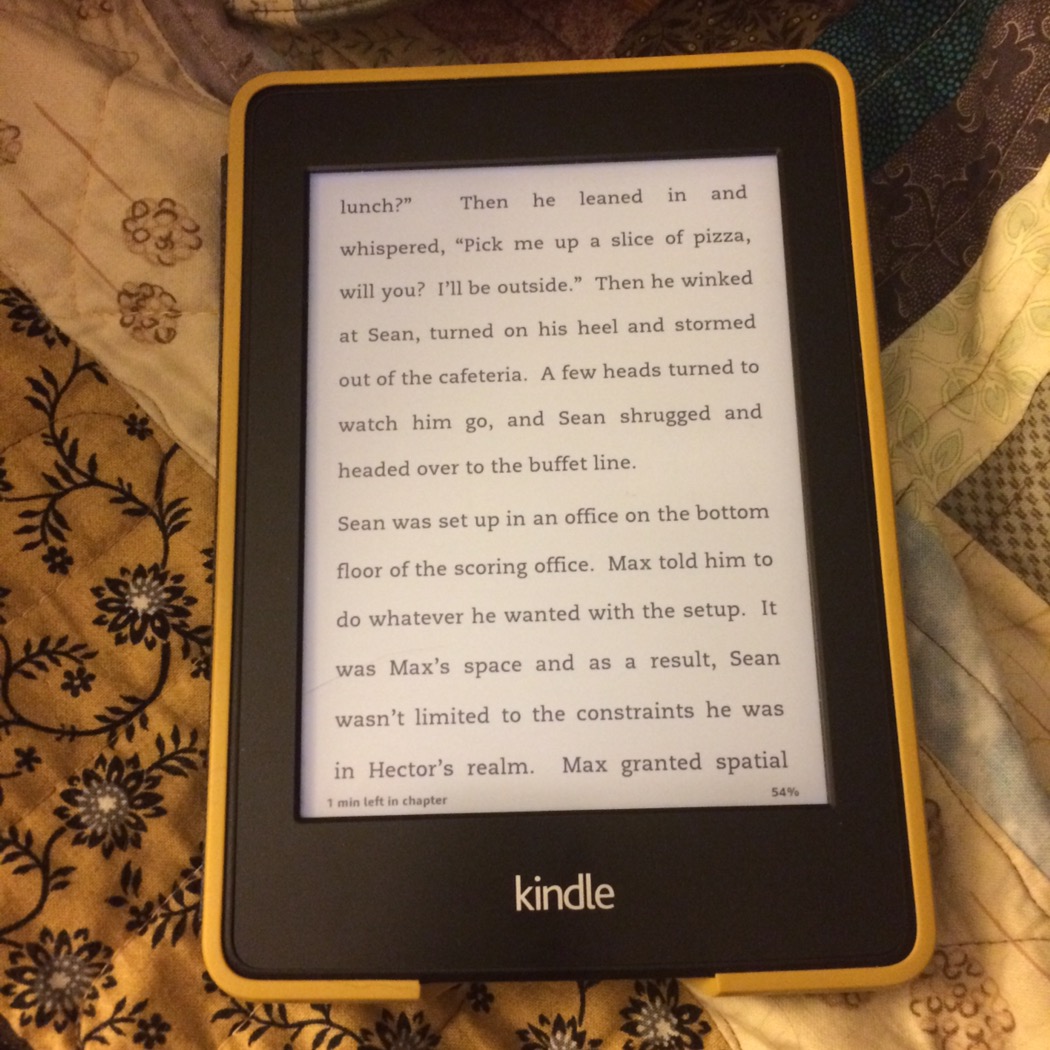
Finally in July inspiration hit.  You can email files to your Kindle and read them on your device.  I have known this since I got my first Kindle and used to send technical reports to it when I wanted to do a last cut for readability.  (If you want to try this for yourself, check out the Send to Kindle page.)  The solution worked.  Unwilling to mark up my Kindle screen with annotations I was able to read my book.  I also did this while I was on vacation so my access to paper and writing implements was limited.  Gloriously, many of the pacing issues I thought I had disappeared when I wasn’t distracted by note taking.  At times my book was good, and once or twice it was really good.  I did come up with a few big picture things I wanted to fix, which I think is the point of the first big read.

Hooray!  Problem solved.  Now all I had to do was edit, which in On Writing takes two measly pages.  You look for big plot holes, awkward character motivation, and ask big questions while you edit.  After two drafts you bestow your book on your ideal reader.  Easy peasy.  Folks, let me tell you that I have been struggling with how to execute those two pages for five months now.  I have begun to understand that King’s book was called On Writing and not On Editing for a reason.

I needed help, because I’d moved past Reader’s Block into Editor’s Block.  Have you ever found yourself in either place?  If so, I’d love to hear your solutions.  Keep reading and I’ll share how I am clearing out the blockages.


My first of a series on reader’s and editor’s block.

Help Me Out of my Writing Closet

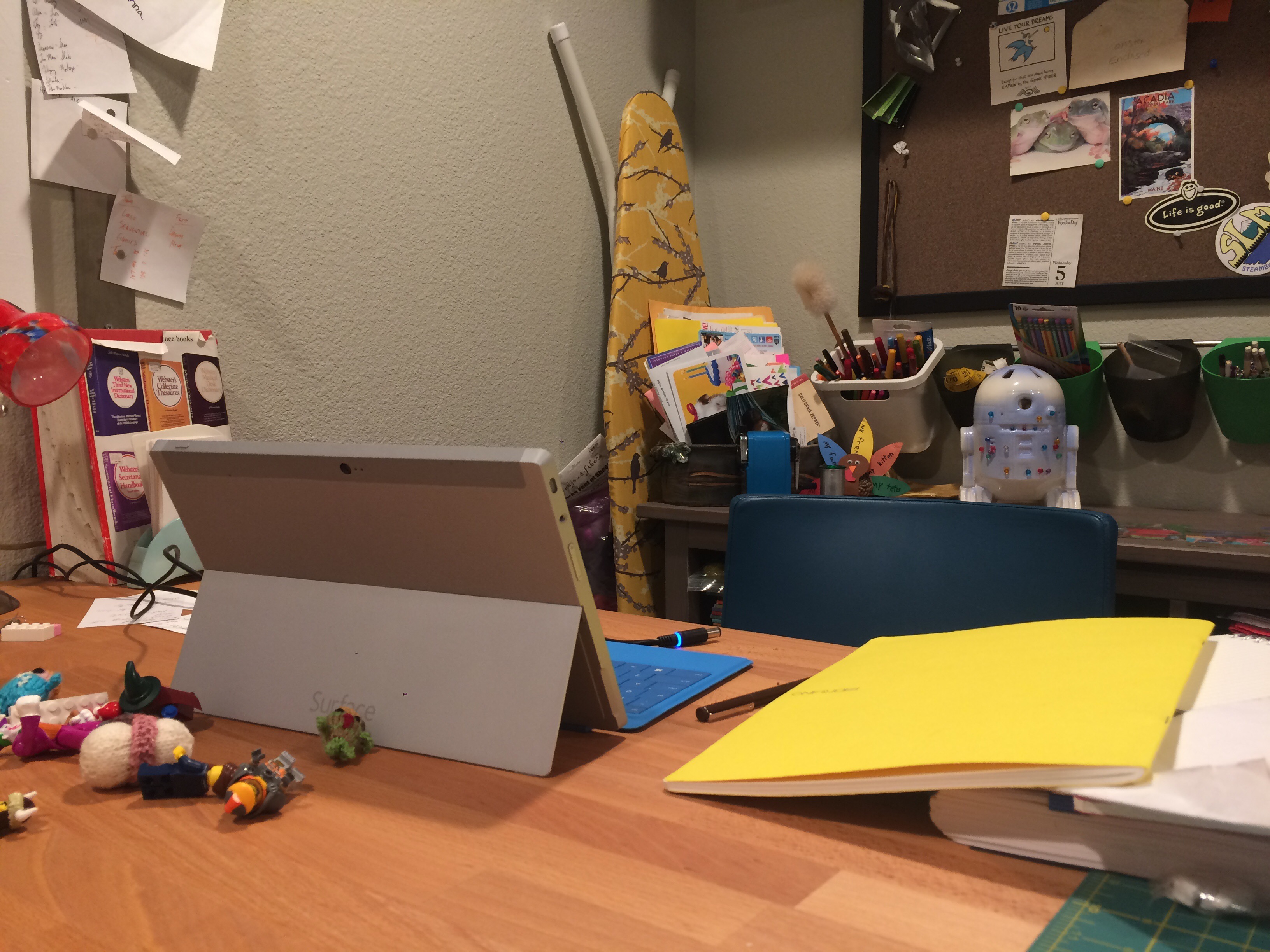
I write in a closet.  It’s a cozy place with everything I need to create my stories.  There is a Microsoft Surface with a blue keyboard and a mouse, because I can’t figure out how to use the trackpad on that thing.  There’s a meandering path to get there and inevitably I find myself distracted by work, husband, child, and friends when I’m on my way to write.  Even when I carve out time to visit my writing closet the way is often blocked by obligations.

The thing I like about my closet is that I decide who visits me there.  Hand selected friends, family members, and other bloggers get to see what I produce in my closet.  If I take a risk and show my work to new people and they don’t like it my closet is off the beaten path so they won’t stumble upon it again.

In my dreams my closet is huge.  It’s an auditorium filled with adoring readers and harsh critics who can’t help but love me.  I sit onstage and read my work with tears coursing down my face and tissues are handed around as emotions fill every nook and cranny of the audience.  There is magic in that space and time stops for my stories.

But, growing out of a closet is scary.  What if when I get to the auditorium it’s empty except for me and my mom?  (Of course  my mom will come, she’s awesome like that.  She will even be there early.)  What if it’s filled with haters and they throw rotten vegetables at me?  What if it’s rundown, rat infested and stinky, and not the space I was dreaming of?  It’s so cozy in my closet, and I’m not sure I want to leave except that dream is so alluring…


I had an enlightening meeting with my family therapist on Friday and she told me I have to stop hiding my writing.  She said I had to go home and post about my writing on my personal Facebook account, but that terrifies me.  Right now my writing world and the real world are very separate, and I’m scared of merging the two.   That said, I’m also tired of living this dual life: one where I live out my hopes and dreams through my stories and another where I look down my engineer’s nose and scoff, “Isn’t writing for 23 year old English majors who can’t find a real job?”  I even have two separate Twitter profiles.  This schizophrenia runs deep.

So blogger friends, as people I trust to hang out in my writing closet all the time, what do you do?  Is your writing life and your real life the same?  Did you ever hide your writing life from your real life?  What happened if you merged the two?  Any advice for how to embrace my writer persona?  Have you put your writing on your personal Facebook account, and if so what happened?


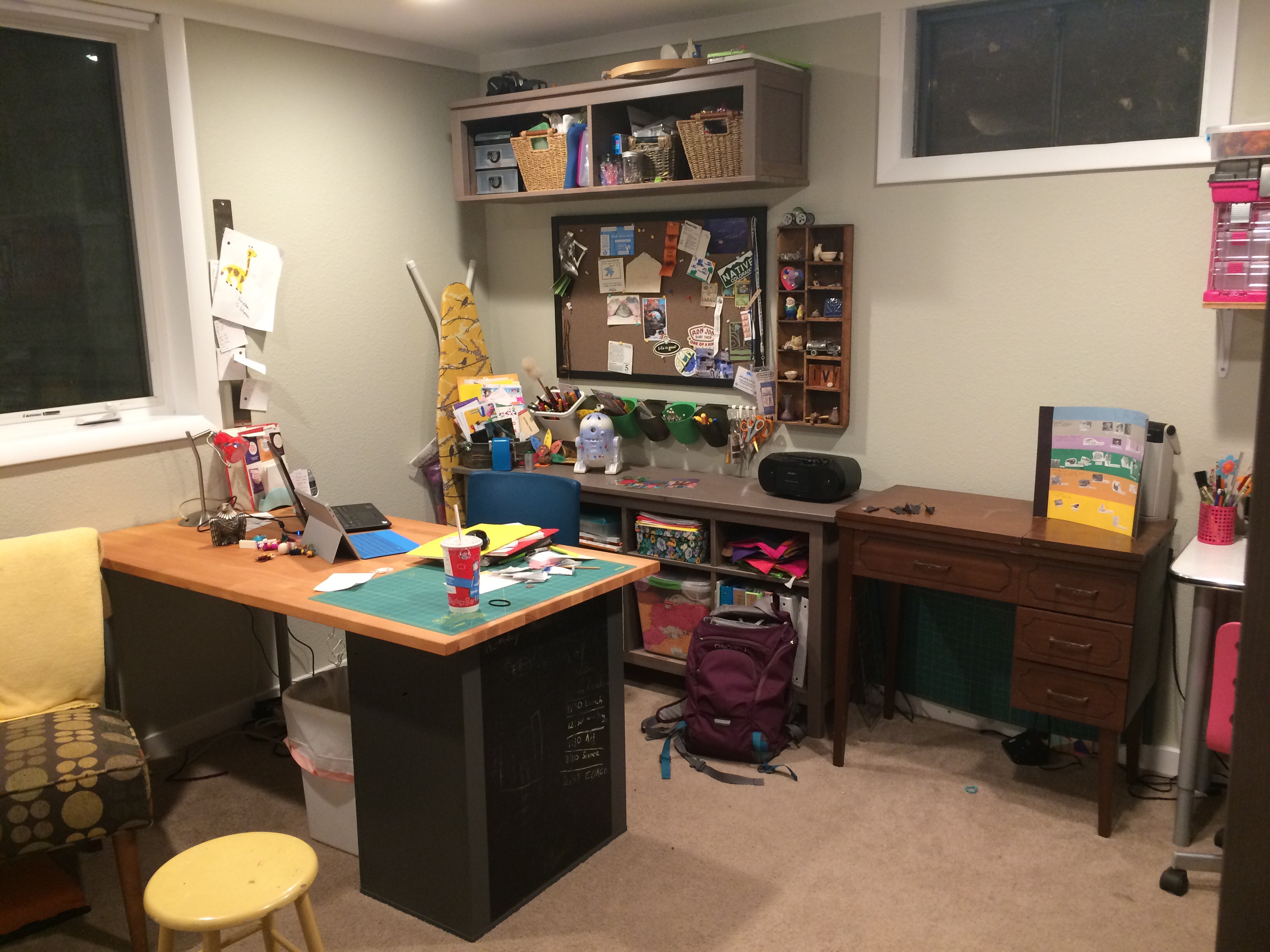
Oh, and I totally don’t write in a literal closet.  I write in a beautiful basement study that was recently remodeled.

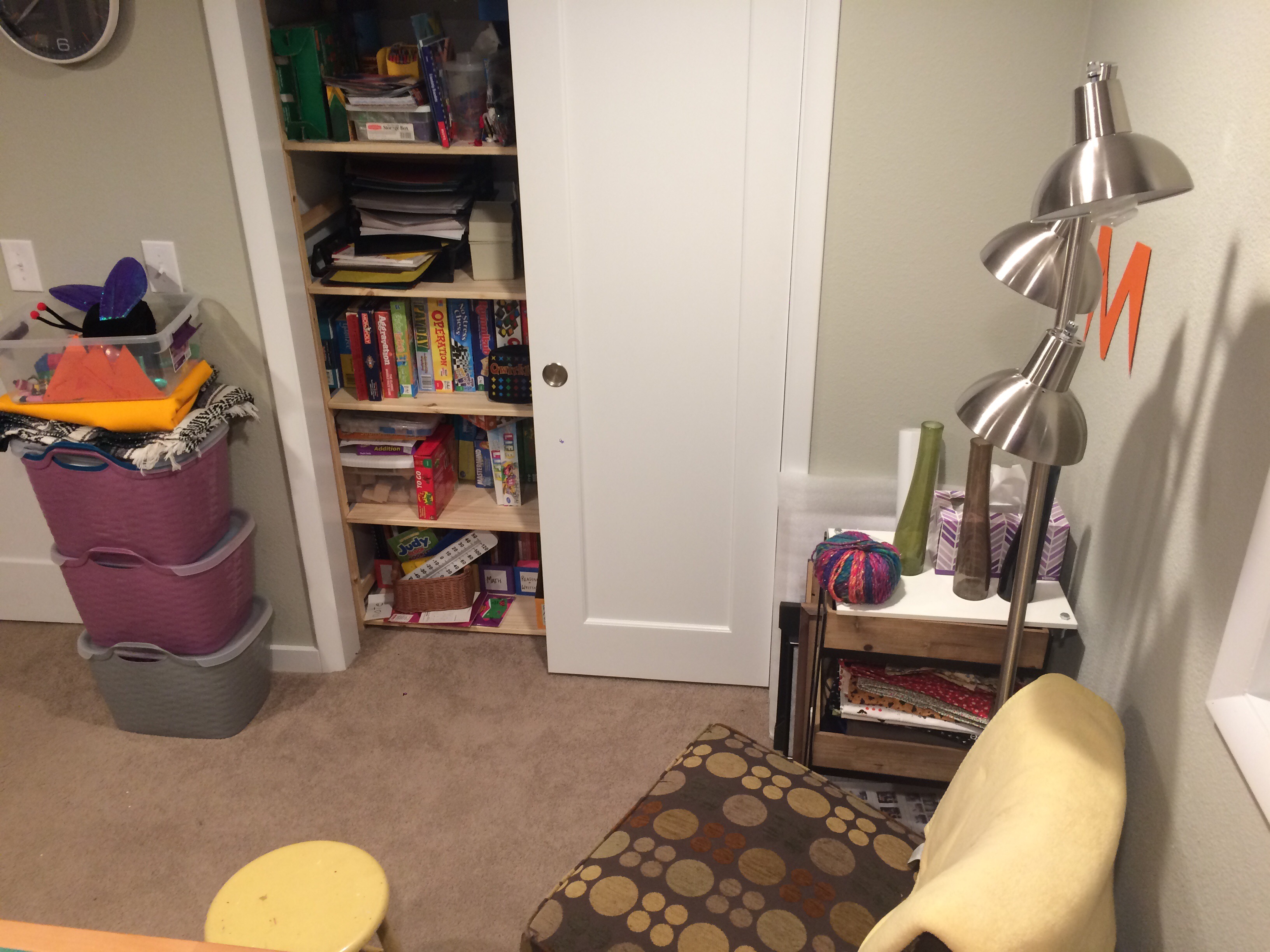
In fact, there’s even a real closet in there.  It’s filled with games and craft supplies, and anyone is welcome to see it.  Even you, my blogging friends.

 I’m looking forward to some help!  Thanks friends!

Is pole-dancing or writing a more embarrassing hobby?

The answer might surprise you.


Today my daughter, who wanted to be a doctor when she was three, announced that now she wanted to be a singer or an artist when she grew up: the singer part is new.  When she was out of earshot I asked my husband, “At what age do I tell her that under no circumstances will she be a singer or an artist?”

“When she’s a junior in high school and she still says that’s what she wants to be,” he replied.

I am a hypocrite.  I aspire to be a writer, but do not want my daughter to want to be an artist.  Somehow it’s okay that I want to be a writer in my spare time because I have a real job.  Since writing is just a hobby, it’s okay…except even then it’s not really.  When I was at a work meeting recently with 60 people we all had to go around the room and tell our “secret talent.”  One woman said she used to have a food blog with over 100,000 views.  One woman can herd goats.  A man explained his art – oil on hammered metal – and when my turn came I said, “I am a knitter.”  Others went on to reveal things like a competitive pole dancing talent and I wondered why I couldn’t bring myself to say that I am a writer or that I recently finished my first novel.  Why is writing more embarrassing than pole dancing or knitting?

One of my issues is that in all areas of life I am in a rut.  My real job isn’t going well and inevitably the place I spend 40 (+ or – 20) hours a week impacts the rest of my life.  When work goes down the toilet so does my general outlook on life, and as a result  work starts going even worse and the spiral continues downward.  Eventually I don’t want to work, parent, write or knit or do much of anything but sit in the parking lot at work and dread my day.

I’m bad at my job which means my whole outlook on me is a mess.  I’m obviously a crappy writer and mother and wife and child and knitter: you should see the mess I just made out of the blanket I am working on.  When things get like this nothing will convince me that I don’t suck and I’ll find endless examples to support my theory.  (My husband will tell you I am a joy to live with when I get in this place.) If I’m getting consistent external feedback that supports my crappiness vision then things go from bad to worse, and I’m getting that right now in vast quantities.  Ergo, I am not in a good place.

Then today I read this amazing article in the Washington Post that promises to fix my “negative self talk” problem.  I am supposed to write three things I liked about myself everyday before I go to bed and read the ever growing list when I wake up each morning.  I emailed the Washington Post article author to commit to the project, because I think accountability is important for me to stick with this.

So here I am at the end of the first rotten day and I need to start my list.  As much as I want to rant about my shortcomings I’ll do the assignment, mostly because I need a deadline to stop being miserable.  If things are not better in 30 days, either due to this exercise or some other reason, I can assess bigger changes.

My first list:

1. I like people even more for their quirkiness: for example my daughter’s friend who only eats ~6 foods.  It makes her parents crazy, but I just adore that uniqueness about her.

2. I said hello to my friend’s stepdaughter when I saw her at the garden store, even thought she was with her mom. It was a little awkward explaining the relationship to her mom, but worth it to see the joy in the girl’s eyes at being recognized by a grown up in an unexpected place.  I like that I think kids are people too.

3.  I asked a friend to recommend a recipe so I can make a dinner for a family friend whose dad died.  She is a very healthy eater, so my normal comfort food options are no good.  I like that when I comfort friends I try to do it in a way that is thoughtful.

Now I need to transcribe these into my notebook and read them tomorrow morning.  Hopefully in 30 days I’ll have a perspective that helps me realize my dreams, gets me out of my own way, and let’s me confidently claim my unique talents.


Finish Something, Again – The Writer’s Digest Version

Here I go again.  I’m sending my short story, The Fisherman, out into the world to see if it can find love and acceptance. I like shooting high, so this time I’m trying for the Writer’s Digest Short Short Story competition.  The word count limit is 1500, and I come in with plenty of room to spare at 1247.  I won’t find out until February if it gets accepted, so once this goes out I’ll turn my attention back to the second draft of my novel, which really needs some attention.

I’m amazed at how the story has morphed with each submission.  I like it better this time than I did with the Glimmer Train draft.  It’s more direct, and more intimate and that’s really a better voice for me.  Having already developed callouses from my first rejection, I’m not as excited this time, but I’m feeling more like a real writer.  Oh yeah, I’m just resubmitting to another contest.  I’m getting it out there.  You know how it is with writing.  I’m so blase.  (How do I make the ticky thing over the e in blase?)  Maybe this time I’ll even forget about the day the winners are announced and not go crazy as the day gets closer.  (Yeah, right!  Winners will be notified by mail by February 29th.  I’m sure if I haven’t heard by then I’ll be stalking the poor postman.)

Stay tuned blogging friends.  In a mere 3 months and 15 days I’ll be a crazy person again, but I’m doing what my BFF Neil Gaiman told me to do.  I’m finishing things and getting them out there.

What’s the Opposite of Prophesy?

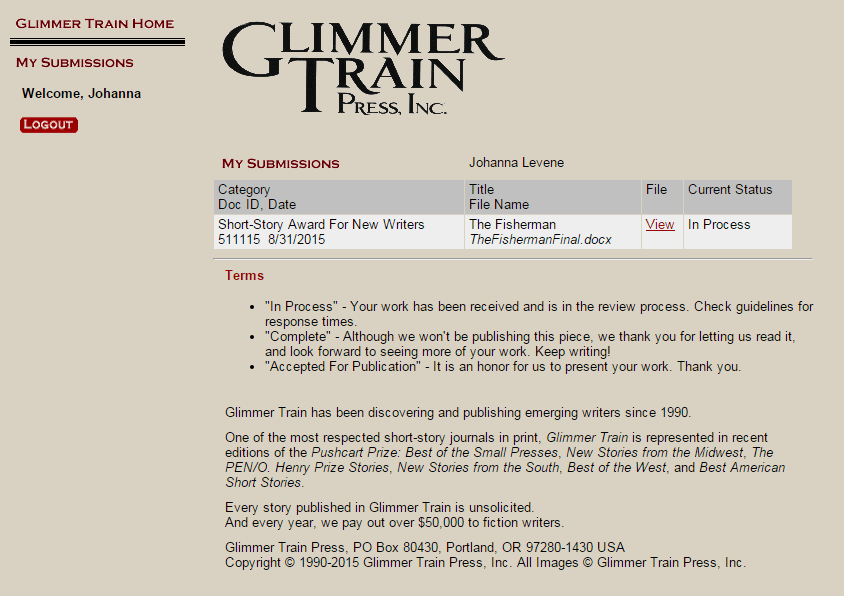
Sunday the Glimmer Train August Short Story Award for New Writers was announced.  I had high hopes for my short story The Fisherman.  As I knew from my status, I didn’t win.  As I learned Thursday, with my excellent web research skills, I did not make the top 25.  Finally I learned, from the official Glimmer Train announcement, that I didn’t even make the honorable mention list.  My first fiction submission and I got nothing.  Crap.  My prophetic dream was the opposite of what I had hoped.  Everyone was right.  You don’t get published the first time.  What a bummer.

I was disappointed, until my husband asked a very important question:

“How did they decide the winner?” asked Mr. Afthead

“Well, these two sisters run the literary magazine, so they decided.” I responded.

“That seems awfully arbitrary.”

He was right.  Two women didn’t like my story.  Yes, it was two women who happen to have the power to publish, but it was just two people.  His words jolted me into remembering why I wrote the story in the first place, and why I wanted to get it out there.  I love that story, and the only way for me to share it with people is to write it down, be brave and send it into the world.  With my first draft something amazing happened.  The story developed a story of it’s own when others read it.  Different people liked parts that other people hated.  Some people thought it was creepy.  Another blogger, On the Lamb Design, tied it to a real life experience, and the similarities are haunting.  Overall the response was not just positive, but thought provoking.

My favorite reaction was my husband’s.  I gave him a copy of a later draft of the story and asked him to read it.  When he finished we had the following discussion:

“This is good,” he said.  “Where did you get it.”

“I wrote it.”

“Reallly?  I thought it was by a real writer.  I like how The Fisherman made the dad a better dad.”

Okay, first of all my husband thought a “real writer” was the story’s author.  Then, he found a story in my words that I never intended.  I didn’t mean for The Fisherman to make the father a better dad, but when my husband found that meaning I saw it too.  When I write and share, something magical happens.  I agree completely with my writing guru, Stephen King, when he says that the reading/writing bond is telepathy.  I write something, and you read it through your lens, and we share a common vision together.  Sometimes our lenses are the same, but sometimes one or the other distorts the story and it changes.  To understand how others find different meaning in my words makes me want to write and read more.

So I’m disappointed that two sisters didn’t like my story, but I’m still going to write, and I’m still going to share, and I’m still going to submit.  This is magic stuff happening, and I’m not about to let it go.

Dream or Prophesy?

On September 13th I had a dream.  (Yes, I know, I hate hearing about other people’s dreams too.  There’s a point.  I’ll be quick.)  I’m holding in my hands a book, well, not quite a book.  It’s papers with book-like organization and book like shape and it has my story in it and pictures of me.  Not quite my story, there are differences, but my story and weird pictures I don’t ever remember being taken, but they are of me.  I flip through the unbound pages to the cover.  Glimmer Train.  “Oh,” a woman’s voice says, “You aren’t supposed to see that yet.”  The story is The Fisherman, which I submit to Glimmer Train for their Short Story Award for New Writers award the end of August.  In my dream I saw my story in the magazine.

I have read countless articles and books on writing.  Get it out there, they all say.  Just keep submitting, they all say.  Then they always say, “I didn’t even remember I had such-and-such story out there, when I found out I got published.”  Okay, I know I’m a newbie, and I know this is my first submission but WHAT?!?!  I’m going crazy here.  I have a full time job, I’m a mom, I’m fostering two kittens from the animal shelter, I’m coaching my daughter’s soccer team and I still check my e-mail several times a day to see if I’ve heard from Glimmer Train yet.  Are these other writers beings with hearts and souls of stone, or am I just nuts?

It’s kind of fun.  The site says, “Winners will be contacted directly the week before the public announcement in our bulletins” and the bulletin is due out November 1st so the longer I don’t hear something the more giddy and butterfly-stomachy I feel.  Sixteen days….but if I don’t hear in nine days is that good news by default?  *flutter flutter*  Then I tell myself, “They just moved to a new computer system.  You know how that goes.  It’s what you do for a living.  They are probably just doing a batch update in the old system and that’s why you don’t know yet.”  *flutter flutter*

I’m trying to keep my rose colored glasses on.  I know the odds are slim.  I know they get tons of submissions.  I know no one gets published on their first submission.  Why did I have to be the one who submit a story when they got a new computer system?  But I haven’t heard anything yet so the excitement builds.

They probably just lost it.  It’s stuck in some bit or byte and they don’t even know it’s there.  November 1st will come and go and I won’t hear anything, and I’ll miss my chance to submit to the Writer’s Digest competition I’m eyeing.  I’ll be that awkward whiny person who e-mails them, “Uh, did you ever read my story?”

Gasp.  Maybe they like it.  Maybe I’ll get published.  Maybe it really is good.  I think it’s good….sometimes.

It’s like a writer’s Christmas Eve, but this time Santa really might not come, or he might bring me coal.  Do you hear the reindeer’s hooves?

I just checked.  Still no e-mail.  Still no update on my submission status.  I’m still In Process – Your work has been received and is in the review process. Check guidelines for response times.  Of course the guidelines are gone, because of the new system.  This is like every user I’ve ever programmed for paying me back for moving stuff they want to find on a website.  When will I move to Complete or *flutter flutter* Accepted for Publication?

Nine more days, or sixteen….

*flutter flutter*

Blogging Awards – Sunshine

Hello readers.  I shall take some time off from my normally scheduled programming to say thank you to Lula Harp for nominating me for the Sunshine Blogger Award.  Like many of these awards, there is a built in blog post built in with the nomination where I get to talk about myself.  So, without further ado here are my responses to Ms. Harp’s questions:

  1. What are 6 things you couldn’t live without?
    • In no particular order: air, food, Diet Dr Pepper, books, outside and my daughter.
  2. What time of day do you do your best writing/work?
    • I really only get to write in the morning (which is horrible) or at night (which is better.)  I think I might write well during the day, but that’s normally when I’m writing e-mails, proposals, performance reviews, and other worky writing things.  Worky writing is not my best or my favorite.
  3. Biscuit or scone?
    • Both, but if I was forced to choose I would pick biscuit, especially because lots of times scones have gross things like cranberries, blueberries and currants in them.  I told my husband recently that if I suddenly had infinite time available I would learn how to make the perfect biscuit.  I have heard rumors that it involves grating the cold butter.  My husband thinks I have lame goals.
  4. Favorite season?
    • Fall, or perhaps spring.  I love fall because I love the weather, the crispness of the air, and the clothes.  I love spring because I love the winter ending and the tiny new plants poking up out of the ground.
  5. What are your thoughts on social media?
    • I’m addicted to Facebook and knowing how my 30ish friends are doing.  That said, all my Facebook friends are also flesh and blood friends, so it’s like an extra expansion of my friendships.  I don’t really get having 500 friends.  I get having 500 connections on LinkedIn, because careers are made via connections.   I loved Twitter when I had 40 minutes on the bus each day, but now that the bus riding is over I can’t make time for it.  I do like the instant connection to anyone, and how it made Neil Gaiman my BFF.  All this said, I know that I need to start figuring out how to better use social media to promote my work, which makes me feel like an old fuddy duddy.
  6. Favorite way to end the day?
    • Sleeping.  I love sleeping.
  7. Best trip?
    • I think the trip my husband and I took to Boston and Maine last year.  We had just come over a really rough stretch and we got to spend 8 days just being grown ups together.  Eating, hiking, walking, kayaking, exploring and just having fun.  As much as I can’t live without my daughter, it was amazing to remember why I choose to live my life with this guy who normally I value for his ability to take out the trash and do dishes.
  8. Would you eat at a restaurant that was really dirty if the food was amazing?
    • So long as the really dirty didn’t involve cockroaches I could see.
  9. How important is it to you to learn something new?
    • Not super important.  I like to learn new things organically.  I would never sit here and think, “Today, I am going to learn French.”  I would learn French if I was going to France, or Montreal.
  10. Have you ever flipped a coin to make an important decision?
    • Nope.  I’m a total spreadsheet decision maker.

Also, I went to the grandmother of my nominator Blabberwockying to check her out.  I love her questions, especially this one:

Do you feel you are at peace with yourself?

  • Absolutely not.  I have moments where I can glimpse peace with myself and it seems so magical.

Finally I went to the great-grandmother of my nominator, to try to see if I could give this award to just anyone.  (It appears I can.)  Then I used her badge for the award, because I like it.  Thanks to A Dark World Inside.

So my nominees are:

Clare from Around Zuzu’s Barn.  Clare’s stories are pure sunshine to me, and I love hearing about her cats (both real and fictional) and her adventures.

Kathy from K E Garland.  Kathy has a wicked wit and a sharp eye for the injustices and idiosyncrasies of life.

On the Lamb Design who is a knitter and a runner like me, which means I love her stuff.  She also was the first person ever who read a fiction piece I wrote and tie it to one of her real life experiences.  She compared my short story, The Fisherman, to this post of a dinner she had in Copenhagen.  Every time I read that post I get chills: it’s total magic.

Alexand Knits for tickling my eyeballs with beautiful knit items.

Now for my questions, if you all are interested in playing along:

  1. Where do you feel at home?
  2. When are you most truly yourself?
  3. What do you love doing, but don’t have enough time for?
  4. What is your biggest time suck?
  5. Who makes you a better person?
  6. If you had to pick four words for a family crest, what would they be?
  7. What do you collect?
  8. Name one word you despise and why do you dislike it?

Thanks again to Lula Harp for the nomination!

Periodic Publishing Posts – Self Publishing?

I’m 6 weeks into an 8 week hiatus from my novel, Hallelujah, and have been working through a list of to-do items prepping me to get my book published.  The last couple of weeks have completely flummoxed me.  I went into this wanting to publish traditionally.  I wanted to have Simon & Schuster, HarperCollins or Penguin Random House on the spine.  (Uh, Penguin and Random House merged?  I had no idea.)  A couple of conversations with some friends of friends has made me wonder what my next step really is.

Conversation #1 – Founder of a self-publishing firm

A dear friend of mine suggested I spend my Sunday morning walking with Polly Letofsky.  Thankfully that’s an organized event anyone can join every Sunday, so it wasn’t a weird idea.  My friend knew that Polly had written a book about her experience walking around the world and she thought Polly might have some ideas about how to get my book published.  What she didn’t know was that Polly had moved on to starting a self-publishing project management and consulting firm, My Word! Publishing.

Polly had all kinds of information about what she does and how her company works.  She encouraged me to self-publish.  She threw around a lot of words I didn’t understand about publishing and the process and encouraged me to contact her for a free evaluation.  Basically her company puts together a publishing team for you: editors, marketing people, writing coaches, and whatever else you need.  Polly told me my first step was to start my own company, which I would later use to publish my book.  This was all fascinating and overwhelming.  Here’s what I took out of my conversation with her:

  1. If you want to make money on your book, you make much less per book with a traditional publication (like $1/book) versus self publishing ($12/book).
  2. An average book sells 2,500 copies.  An average self published book sells 250.
  3. You need to understand your own goals for publishing.

The first two bullets are a math problem.  Jojo sells 2500 copies of her first book and makes $1/book.  Anna sells 250 copies of her book for $12/book.  Who made the most money publishing her book?  If you play the averages, self-publishing wins, but by only $500.  However, this is where bullet number 3 comes in.

Once I had time to think I realized that my goal is not to make lots of money.  My goal is to get lots of people to read my book.  In my dreamy dream world I want to publish a book that people want to read, which is measured by them buying lots of books.

In my limited knowledge of how all this works, I didn’t even consider self-publishing because I do not believe that I could write a book lots of people want to read by myself.  People are not interested in a book with grammar errors, writing issues, and juvenile construction.  I know I need a whole team of people around me to publish a quality book and that meant traditional publishing.  Polly opened my eyes to the fact that the consolidation of the publishing houses means that there are lots of publishing people out there waiting to support self-publishers.  Once I read my book and determine if I want to go forward with it I’ll meet with her and see how her process works.  More on that here when the meeting happens

Conversation #2 – A self-published author

Jamie Ferguson is a friend of a friend and she published With Perfect Clarity in 2013.  I read her book and we’ve had a couple of e-mail conversations back and forth.  Hopefully we can meet in person and chat about her process in detail, but what I found out from her was that she also self-published through her company, Blackbird Publishing.

When I found all this out I did a double take.  This idea of starting your own company to publish a book seemed crazy when Polly mentioned it to me, and here I already had a data point telling me that was what people really did.  Jamie had editors tell her that the book was good, but would be hard to publish traditionally and an agent who was interested, but wanted her to make big changes, so she self published.

Both these conversations were interesting, and at least opened my eyes to what self-publishing means.  I’m not as against that direction as I was, but I’m a little overwhelmed by the thought that I have to write a book and then find a team, and then pay the team to edit, market and publish my book.  (If the averages work out I have $500 I could use to pay all those people and end up cost neutral.)  The flip side is to continue to try the traditional route.  I’m torn, but I don’t know enough yet.  My next steps are to learn more by meeting with Polly and Jamie.

I’ve got two weeks left until the big read, and I’m pretty comfortable where everything stands on my list.  I’ve got some work to do on a CV, and I have two more personal connections to exercise.  (I may wait on both of those until after the first reading, because they are connections I don’t want to use unless I’m really going to publish this thing.)  The only other item on my list is an elevator pitch, and that’s got to wait until I read, because I’m starting to forget the details of my book.  That was the whole idea of this little break.

I’m getting excited and nervous for two weeks from now.

Glimmer Train Submission

Get it Out There – The Short Story Edition

Back in June I blogged about going to see my BFF Neil Gaiman speak and his message to new writers.  Like many other established authors out there, his suggestion was to finish something, then get it out there.  Since that day I have finished a first draft of a short story and my first novel.  While waiting for my novel age, I have been working on nine tasks to get me ready for the effort of creating a second draft of my novel then finding an agent and publisher.  One of those tasks was to polish my short story, The Fisherman, and get it out there.  Well, I actually said “see how I feel about getting it out there,” but honestly, I feel pretty darn good.  It is out there.  Monday night I corrected my last few inconsistencies, paid my $15 and hit submit. My story is now officially in the Glimmer Train Press “Short-Story Award For New Writers.”  Can I get a hallelujah?!?  I’ll find out by November 1st if I win or not.  Time for more waiting.

I’m really, really glad I submit The Fisherman before tackling the editing process on my novel.  My story was SHORT (1241 words) and my novel is LONG (98,942 words).  Editing my short story was a gut wrenching crabby weekend of work.  If I edit my novel at the same rate I’m going to be crabby for 80 days!  (At one point this weekend I remembered another message from Neil Gaiman where he said people think that writing is ethereal but really it’s wandering around grouchy in a bathrobe.  Yep, he was talking second drafts, I’m sure.)  However, I learned some great stuff that I think will make editing the novel easier now that this effort is under my belt:

  1. I need a reader who believes in me, loves my work, and will remind me why I’m doing this when the bathrobe lady takes over and wants to hide in the basement burning my novel.  I’m lucky enough to have two of those readers.  One of them is my mom who also happens to be my ideal reader and my first editor.  The other one is a dear friend who makes time to encourage me even while she’s living her own crazy life.  Having that really honest joyful reassurance is so important.  Find that person. Buy them presents.  Nurture them because you are going to need them.
  2. I need a reader who is pragmatic and good at the rules of grammar.  My husband had to read my story twice this weekend.  The first time he agreed with my mom, “Yeah, you’ve got a lot of ‘ands’ in this story” and the second time he found two inconsistencies that were nit-picky but the difference between a kind-of-final draft and a final draft. Having someone who will know if your prepositions don’t match is awesome.  He never gushed about my story, but that’s okay.  Other people handled the gushing.
  3. I need a plan.  If the story doesn’t make Glimmer Train, that’s okay.  The deadline for the Writer’s Digest Short Short Story competition is November 16th.  That’s where The Fisherman is going next if it doesn’t find a home at Glimmer Train.
  4. I need a deadline. Once I found my competition and realized it was due 8/31 I got motivated.  I couldn’t hang out in the bathrobe too long.  I’m hoping that I can make deadlines for my novel that mean something to me and keep me motivated.  Otherwise I might have to find some weird novel competition.  (Hopefully this means I’ll be good with deadlines if and when someone else ever cares about my stuff getting published.)

Those things are all great, but I also learned one really big writing lesson.  A game changer of a lesson.  I am chickenshit.  Once my mom and Mr. Afthead pointed out all the “ands” in my story I realized what I was doing.  I was making the reader do the work.  Description after description read,

“When the sun is low and the puffy cloud-filled sky is painted pink, purple and orange, and the shadows are deep enough to hide details of faces and bodies, the door will open and he will slip out to join the families on the banks of the river with his rod and reel.”  – 4 “ands” in one sentence

I had 69 ands in my first draft. Let’s pause and consider 69 of 1241 words were AND: almost 6%.  Ugh.  I cut that down to 31 through updates like,

“The sun must be low in a sky filled with orange puffy clouds.  The shadows must be deep enough to hide the details of face and body.  When the conditions are right he will slip out to join the families on the banks of the river with his fishing rod.” – 1 “and” in 3 sentences

What’s the difference between the first and second versions.  Lots of stuff, but in my mind the difference is that in the first version I am paranoid that the reader won’t see what I want them to see.  So I paint a very detailed picture in a very complex sentence.  I give them a magnifying glass and some paint of their own – in case they don’t like what they see – and a guided tour of the picture complete with one of those narration phones you get at a museum.  In the second version I am brave.  I assume the reader has their imagination on and can paint their own picture in their mind and we can move on together.  Are their orange puffy clouds the same as mine?  Do they really understand the conditions?  That is scary, but my favorite part of the story is the magic, but through over-describing (The child is excited and terrified.  The dad is teary-eyed and proud.) I was losing the magic.

Thank goodness by nature I’m a taker-outter and not a putter-inner, so the edits weren’t hard once I knew what they were.  I honestly believe that every reader has “better things to do” than read a book.  They have bills to pay and mother’s to call and a house to clean and kids to bathe and endless ands to stick into their writing.  If I make them work too hard they will leave.  If I tell them exactly what they need to know, and maybe a little less, they will keep reading because they can’t stop.  They will paint their picture in their head and want to know how it turns out.  I want my stories to beg to be read, but if they are tedious because I am scared they won’t get read.  So watch out novel!  I’m coming to you and I am brave and ready to chop you down to size.  I’m bringing my cheerleader readers and my nitpicker with me too.  We are a fierce team and taking on new members if you want to join us.

Only 59 days until I find out if I won the competition or not. 23 days until I can read my novel. Tick Tick.